

The best self-service ad networks in 2026 include Media.net, Adsterra, PropellerAds, Adcash, MGID, Infolinks, BidVertiser, Clickadu, HilltopAds, RichAds, and Monetag. These networks support multiple monetization formats, including display banners, native ads, push notifications, interstitials, video ads, contextual ads, and programmatic inventory.
Self-service ad networks give publishers, bloggers, website owners, app developers, and digital media platforms a way to earn revenue without relying on account managers or manual approvals for every change. Publishers can create ad placements, control monetization strategies, test formats, and optimize campaigns directly from a dashboard.
Depending on the network, publishers can monetize their traffic through CPM, CPC, CPA, CPL, or revenue share models while using automation tools, AI optimization, and real-time bidding systems.
However, features alone should not determine which network you choose. The best self-service ad network should also provide strong advertiser demand, reliable payments, transparent reporting, ad-quality controls, anti-fraud protection, and flexibility to match your traffic and audience.


What Are Self-Service Ad Networks?
Self-service ad networks are advertising platforms that allow users to manage campaigns independently without requiring manual approval or account managers. These platforms provide a user-friendly dashboard where users can control every part of their campaign, making the process faster, more flexible, and scalable.
Self-serve ad platforms empower both publishers and advertisers to:
- Launch campaigns instantly
- Control budgets and targeting
- Optimize performance in real time
- Access analytics dashboards
With a self-serve platform, you can choose ad formats such as push, popunder, native, display, or video, define targeting options like location, device, and audience interests, and set your budget using models like CPC, CPM, or CPA. You can also upload creatives, track performance in real time, and optimize campaigns using AI-based tools and advanced bidding strategies. Because of this control and efficiency, self-service ad networks are widely used in affiliate marketing, eCommerce, app promotion, lead generation, and brand awareness campaigns.
Advantages of Self-Service Ad Networks
How Do Self-Service Advertising Networks Work?
Self-service advertising networks follow a structured process that allows advertisers to launch, test, and scale campaigns without relying on manual support. The entire system is designed for speed, control, and real-time optimization.
- Account setup: You create an account and provide basic details about your business, website, and campaign goals.
- Funding your account: Before launching campaigns, you add funds or set up billing. Each platform has its own minimum deposit requirements.
- Campaign creation: You choose the ad format, add your landing page, upload creatives, and set your budget, bid, and campaign settings.
- Audience targeting: You define who will see your ads by selecting options like country, device, operating system, browser, and user interests.
- Performance optimization: Once your campaign is live, you monitor key metrics such as impressions, clicks, conversions, CPC, CPM, and ROI, then adjust targeting, bids, or creatives to improve results.
- Scaling campaigns: After identifying what works, you increase budgets and expand to new audiences, geographies, or ad formats to maximize profit.
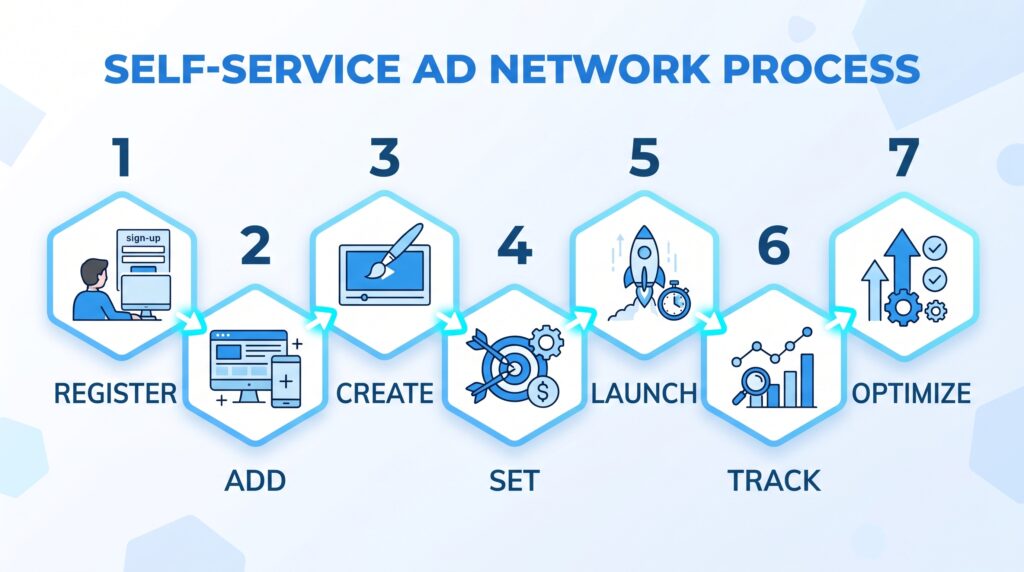
This step-by-step workflow is what makes self-service ad networks so powerful. Advertisers can quickly move from testing to scaling without delays, giving them full control over performance and growth.
How We Evaluated the Best Self-Service Ad Networks
These self-service ad networks were evaluated from a publisher monetization perspective, with priority given to platforms that allow full control over ad placements, demand access, and revenue optimization without requiring managed account support.
We Considered:
- Self-Service Monetization Control: Ability for publishers to manage ad placements, formats, and settings independently
- Ad Formats & Inventory: Availability of display, native, push, pop, video, and other monetization formats
- Advertiser Demand: Access to global demand sources and fill rate consistency
- Revenue Potential: CPM, CPC, CPA models and overall earning opportunities
- Payment Reliability: Minimum payout thresholds, payment frequency, and supported withdrawal methods
- Publisher Accessibility: Approval requirements, traffic thresholds, and ease of onboarding
- Reporting & Optimization: Real-time dashboards, analytics, and revenue optimization tools
- Ad Quality & Safety: Control over ad types, filtering options, and user experience impact
- Traffic Quality Handling: Anti-fraud systems and invalid traffic protection
- Platform Reputation: Market presence, reliability, and relevance for publishers
Payment terms and publisher details were verified using official network documentation and up-to-date platform data wherever available. When differences appeared between sources, priority was given to the most recent and publisher-focused information.
15 Best Self-Service Ad Networks in 2026
Below is a detailed review of the best self-service advertising networks in 2026:
- PropellerAds
- Adsterra
- Clickadu
- ROI Ads
- AdsCompass
- ClickAdilla
- RichAds
- AdMaven
- HilltopAds
- RollerAds
- SmartyAds
- AdLib DSP
1. PropellerAds
Company Overview
| Features | Details |
|---|---|
| Founded | 2011 |
| Headquarters | Cyprus |
| Ad Formats | Popunder, Push Notifications, In-Page Push, Interstitial, Native, Direct Link |
| Commission Type | CPM, CPC, CPA |
| Minimum Payment | From $5 (depends on payment method) |
| Payment Frequency | Weekly |
| Payment Methods | PayPal, Payoneer, Skrill, WebMoney, Wire Transfer, Bank Cards, Cryptocurrency |
PropellerAds is one of the most popular self-service ad networks, known for its large global traffic and easy-to-use dashboard. It allows advertisers and publishers to launch campaigns in minutes, choose formats like push, popunder, and native ads, and control everything from targeting to budget in one place. The platform also offers real-time statistics, audience targeting, and campaign management tools, making it simple to track and improve performance.
PropellerAds is best for affiliates, media buyers, and performance marketers who want fast scaling and automation. Its AI-powered optimization tools, smart bidding options, and huge traffic volume help reduce costs and improve conversions. With support for multiple pricing models like CPC, CPM, and CPA, it gives users flexibility to test, optimize, and grow campaigns efficiently across global markets.
Requirements for Publishers
- Website or traffic source: Publishers must own a website, mobile app, or verified traffic source that allows proper ad placement and tracking.
- Account approval: Publishers must create an account and complete a basic approval process before accessing monetization features and ad inventory.
- Traffic quality: All traffic must be real, consistent, and free from bots, forced redirects, or misleading and incentivized sources.
- Ad placement compliance: Publishers must correctly implement ad formats and follow placement guidelines for push, popunder, and native inventory.
- Policy compliance: All content and traffic sources must fully comply with platform policies, including restrictions on prohibited or sensitive verticals.
2. Adsterra
Company Overview
| Features | Details |
|---|---|
| Founded | 2013 |
| Headquarters | Limassol, Cyprus |
| Ad Formats | Popunder, Social Bar, In-Page Push, Interstitial, Native, Display, SmartLink |
| Commission Type | CPM, CPC, CPA |
| Minimum Payment | From $5 (depends on payment method) |
| Payment Frequency | Bi-weekly (Net-15) |
| Payment Methods | PayPal, Paxum, WebMoney, Wire Transfer, Cryptocurrency, Bank Cards |
Adsterra is a powerful self-service ad network known for its massive global reach and high-demand traffic. It allows advertisers and publishers to create and manage campaigns directly from a simple dashboard, with full control over targeting, budgets, and performance. The platform supports popular formats like Social Bar, push, popunder, and native ads, making it easy to reach users across different devices and geographies. With access to billions of impressions and advanced targeting options, it helps deliver ads to the most relevant audiences.
Adsterra is best for performance marketers, affiliates, and publishers who want fast scaling and flexible monetization. Its self-serve system includes smart tools like CPA Goal optimization, automated bidding, and real-time tracking, which help improve conversions while reducing manual work. Whether you are testing campaigns or scaling globally, Adsterra offers strong traffic quality, multiple pricing models (CPM, CPC, CPA), and reliable performance across different verticals.
Requirements for Publishers
- Website ownership or access: Publishers must own or control a website or app where ad code can be integrated and monetization can be enabled.
- Account approval: Publishers must register an account and pass a standard review process before ads are approved and activated.
- Traffic quality: Websites must generate real, stable traffic without bots, misleading clicks, or artificially inflated engagement signals.
- Ad integration setup: Publishers must correctly install ad scripts and ensure proper functioning across supported formats and devices.
- Policy compliance: Publishers must follow Adsterra policies, including content restrictions, ad placement rules, and user experience guidelines.
3. Clickadu
Company Overview
| Features | Details |
|---|---|
| Founded | 2014 |
| Headquarters | Prague, Czech Republic |
| Ad Formats | Banner, Popunder, Push Notifications, In-Page Push, Video Pre-Roll, Instant Text Message (ITM) |
| Commission Type | CPM |
| Minimum Payment | $50 (higher for Wire Transfer) |
| Payment Frequency | Weekly / Twice Monthly / Monthly (depending on agreement) |
| Payment Methods | PayPal, Paxum, WebMoney, Wire Transfer |
Clickadu is a global self-service ad network that allows advertisers and publishers to launch and manage campaigns independently through a simple dashboard. It offers multiple ad formats such as popunder, in-page push, video, banner, and instant text ads, giving users flexibility to reach audiences across different devices and GEOs. With billions of daily impressions and strong global coverage, it helps deliver consistent traffic and monetization opportunities.
Clickadu is best for affiliates and performance marketers who want fast campaign setup and full control over targeting and budgets. Its self-serve platform includes advanced features like real-time analytics, AI-based optimization, smart bidding models (CPC, CPM, SmartCPA), and fraud filtering systems to improve traffic quality and conversions. Overall, it is a strong choice for scaling campaigns quickly while maintaining control and performance across different ad formats.
Requirements for Publishers
- Website or app availability: Publishers must have a live website, app, or approved traffic source suitable for ad placement and monetization.
- Account approval: Publishers must register and complete an approval process before gaining access to the platform and monetization tools.
- Traffic quality: Traffic must be organic, verifiable, and free from bots, fraudulent activity, or manipulated engagement sources.
- Ad format compatibility: Websites must support multiple ad formats such as popunder, push, banner, or video placements.
- Policy compliance: Publishers must comply with Clickadu policies, including traffic standards, content rules, and ad placement requirements.
4. ROIads
Company Overview
| Features | Details |
|---|---|
| Founded | 2017 |
| Headquarters | Cyprus |
| Ad Formats | Push Notifications, In-Page Push, Popunder, Direct Link |
| Commission Type | CPC, CPM |
| Minimum Payment | $50 |
| Payment Frequency | Weekly |
| Payment Methods | PayPal, WebMoney, Paxum, Cryptocurrency |
ROIads is a self-service advertising platform focused on push, popunder, and in-page push ads, designed to deliver high-performance traffic for better ROI. It allows advertisers to create and manage campaigns through a simple dashboard with full control over targeting, bids, and budgets. With over 900 million daily impressions across 150+ countries, ROIads provides strong global reach and supports advanced targeting options like GEO, device, OS, browser, and connection type, making it easier to reach the right audience.
ROIads is best for affiliates and performance marketers who want data-driven optimization and scalable campaigns. It offers powerful tools like AI bidding, micro bidding, Target CPA, and automated rules that help improve conversions while reducing manual work. With strong performance in verticals like finance, antivirus, and iGaming, it’s a solid choice for running high-ROI campaigns. However, due to its $250 minimum deposit and advanced features, it is more suitable for serious marketers rather than beginners.
Requirements for Publishers
- Website or traffic source: Publishers must own a website, mobile app, or verified traffic source that supports ad placement and monetization.
- Account approval: Publishers must register an account and complete a standard approval process before accessing the platform and ad inventory.
- Traffic quality: Traffic must be real, consistent, and free from bots, forced redirects, or misleading and incentivized sources.
- Ad format compatibility: Websites must support formats such as push, popunder, or in-page ads and allow proper integration.
- Policy compliance: Publishers must comply with ROIads policies, including content guidelines, traffic standards, and ad placement rules.
5. AdsCompass
Company Overview
| Features | Details |
|---|---|
| Founded | 2013 |
| Headquarters | United Kingdom |
| Ad Formats | Pop, Push Notifications, In-Page Push, Native, Banner, Video |
| Commission Type | CPC, CPM |
| Minimum Payment | $50 |
| Payment Frequency | Monthly |
| Payment Methods | PayPal, WebMoney, Paxum, Capitalist, Cryptocurrency |
AdsCompass is a self-service ad network focused on push, in-page push, and native advertising, making it a strong choice for performance-driven campaigns. It allows advertisers and publishers to manage campaigns directly through a simple dashboard, with full control over targeting, budgets, and creatives. The platform supports multiple formats including push, native, pop, and video, and operates across 200+ countries, giving users access to a wide global audience.
AdsCompass is best for affiliate marketers and media buyers who want high-converting traffic and advanced targeting options. It offers detailed targeting by GEO, device, OS, and carrier, along with real-time bidding and analytics to optimize performance. With direct publisher traffic, anti-fraud systems, and strong competition between advertisers, it helps improve ad performance and increase earnings, especially in competitive niches.
Requirements for Publishers
- Traffic source submission: Publishers must provide a website, landing page, or traffic source for verification before monetization access is granted.
- Account approval: Publishers must create an account and pass a review process to ensure eligibility for platform access and ad delivery.
- Traffic quality: Traffic must be legitimate, consistent, and free from bots, forced clicks, or deceptive acquisition techniques.
- Ad format support: Websites must support formats like push, native, or pop ads and allow proper integration of ad code.
- Policy compliance: Publishers must follow platform policies, including traffic standards, advertiser safety, and ad placement guidelines.
6. ClickAdilla
Company Overview
| Features | Details |
|---|---|
| Founded | 2016 |
| Headquarters | Dublin, Ireland |
| Ad Formats | Popunder, Push Notifications, In-Page Push, Banners, Native, Video, Direct Link |
| Commission Type | CPM, CPC, RevShare |
| Minimum Payment | $50 |
| Payment Frequency | On-demand (typically within 3–7 days) |
| Payment Methods | Bitcoin, USDT, USDC, Capitalist, Wire Transfer |
ClickAdilla is a high-volume self-service ad network designed for affiliates and performance marketers who want fast campaign setup and global reach. It offers multiple ad formats including push, popunder, native, banner, and video, all managed through a simple dashboard. With billions of daily impressions and coverage across 200+ countries, it provides strong traffic availability and flexible targeting options for different campaign types.
ClickAdilla is best for beginners and arbitrage publishers looking for low entry and quick scaling. Its platform includes real-time optimization, smart bidding (like Smart CPM), A/B testing, and detailed analytics to improve performance over time. The combination of easy setup, large traffic volume, and automation tools makes it a popular choice for affiliates who want to test campaigns quickly and grow profitable traffic sources efficiently.
Requirements for Publishers
- Website or traffic access: Publishers must own or control a website or traffic source suitable for ad placement and monetization.
- Account approval: Publishers must register and complete a basic approval process before accessing campaign tools and ad inventory.
- Traffic quality: Traffic must be real, consistent, and free from bots, misleading redirects, or low-quality incentivized sources.
- Ad implementation: Publishers must correctly implement ad formats such as push, popunder, or native within supported environments.
- Policy compliance: Publishers must comply with ClickAdilla rules, including content guidelines, traffic standards, and placement policies.
7. RichAds
Company Overview
| Features | Details |
|---|---|
| Founded | 2018 |
| Headquarters | Estonia |
| Ad Formats | Push Notifications, In-Page Push, Popunder, Calendar Push |
| Commission Type | CPM, CPC |
| Minimum Payment | $50 |
| Payment Frequency | Weekly |
| Payment Methods | PayPal, WebMoney, Capitalist, Wire Transfer |
RichAds is a performance-focused self-service ad network known for its strong push and native traffic, along with formats like popunder, in-page push, and direct click. It allows advertisers and publishers to create and manage campaigns independently through a powerful dashboard, with access to global traffic across 220+ countries and billions of daily impressions. The platform supports CPC and CPM models and provides detailed targeting options, making it easy to reach the right audience based on device, GEO, and user behavior.
RichAds is best for affiliates and performance marketers who want high ROI campaigns with automation. It offers advanced optimization tools like Target CPA, Performance Mode, micro bidding, and automated rules, which help improve conversions while reducing manual work. With AI-driven optimization and high-quality traffic, RichAds makes it easy to test, optimize, and scale campaigns efficiently, especially in competitive niches like finance, dating, and iGaming.
Requirements for Publishers
- Traffic source approval: Publishers must submit a website or traffic source for verification before gaining access to monetization features.
- Account setup: Publishers must create and verify an account to enable ad serving and performance tracking capabilities.
- Traffic quality: Traffic must be authentic, user-driven, and free from bots, spam activity, or forced engagement techniques.
- Push subscription rules: Push traffic must be user-consented and cannot involve forced opt-ins or misleading subscription methods.
- Policy compliance: Publishers must follow RichAds policies, including advertiser safety standards and traffic quality requirements.
8. AdMaven
Company Overview
| Features | Details |
|---|---|
| Founded | 2015 |
| Headquarters | Israel |
| Ad Formats | Push Notifications, Popunder, Interstitial, Native, Content Locker |
| Commission Type | CPM, CPC, CPA |
| Minimum Payment | $50 |
| Payment Frequency | Weekly |
| Payment Methods | PayPal, Payoneer, Wire Transfer, Bitcoin |
AdMaven is a well-known self-service ad network that focuses on high-volume monetization with formats like popunder, push notifications, and in-page push ads. It offers a simple dashboard where advertisers and publishers can launch and manage campaigns independently, with access to over 1 billion daily impressions and global traffic across multiple devices. The platform also includes advanced targeting options and real-time analytics, helping users reach the right audience and track performance easily.
AdMaven is best for affiliates and publishers looking for easy approval and strong monetization across global traffic. Its self-serve system includes AI-driven optimization, automated campaign tools, and flexible ad formats that help improve conversions and ROI. With beginner-friendly setup, wide inventory, and consistent demand, it remains a solid choice for scaling campaigns quickly while maintaining control and performance.
Requirements for Publishers
- Website or app ownership: Publishers must own or manage a website or app where ads can be integrated and displayed.
- Account approval: Publishers must register and complete an approval process before accessing monetization tools and ad inventory.
- Traffic quality: Traffic must be legitimate, stable, and free from bots, fake clicks, or artificially generated engagement.
- Ad implementation: Publishers must correctly integrate ad code and ensure compatibility across supported formats and devices.
- Policy compliance: Publishers must follow AdMaven policies, including content standards, traffic rules, and user experience guidelines.
9. HilltopAds
Company Overview
| Features | Details |
|---|---|
| Founded | 2013 |
| Headquarters | United Kingdom |
| Ad Formats | Popunder, In-Page Push, Video, Banner, Native |
| Commission Type | CPM, CPC |
| Minimum Payment | $20 |
| Payment Frequency | Weekly |
| Payment Methods | PayPal, Paxum, WebMoney, Wire Transfer, Cryptocurrency |
HilltopAds is a self-service ad network known for high CPM popunder traffic and strong global reach, allowing advertisers and publishers to manage campaigns directly through a user-friendly dashboard. It supports multiple ad formats including popunder, in-page push, video, and banners, with access to billions of impressions across 250+ countries. The platform also includes advanced targeting, real-time bidding, and built-in anti-fraud systems to ensure better traffic quality and performance.
HilltopAds is best for publishers and affiliates looking for high-volume traffic and fast payouts. It offers weekly payments on a Net-7 basis with low minimum payout options starting around $20 depending on the method. Features like anti-adblock technology, automated optimization, and flexible campaign control make it a strong choice for scaling monetization, especially for pop traffic and video-based campaigns.
Requirements for Publishers
- Website or traffic source: Publishers must provide a working website or traffic source suitable for ad placement and monetization.
- Account approval: Publishers must create an account and pass a review process before gaining access to the platform.
- Traffic quality: Traffic must be real, verifiable, and free from bots, fraudulent clicks, or manipulated engagement signals.
- Ad format support: Websites must support formats like popunder, video, or display ads and allow proper implementation.
- Policy compliance: Publishers must comply with HilltopAds policies, including traffic rules, content standards, and placement guidelines.
10. RollerAds
Company Overview
| Features | Details |
|---|---|
| Founded | 2019 |
| Headquarters | Czech Republic |
| Ad Formats | Push Notifications, In-Page Push, Popunder |
| Commission Type | CPC, CPM |
| Minimum Payment | $50 |
| Payment Frequency | Weekly |
| Payment Methods | PayPal, Payoneer, WebMoney, Capitalist, Wire Transfer |
RollerAds is a performance-focused self-service ad network that specializes in push, in-page push, and direct click (OnClick) advertising formats. It allows advertisers and publishers to create and manage campaigns from a single dashboard, with full control over targeting, budgets, and bidding strategies. The platform delivers billions of daily impressions across global traffic and offers advanced targeting options like GEO, device, OS, browser, and user behavior, helping reach highly relevant audiences.
RollerAds is best for affiliates and performance marketers who want high ROI campaigns with smart automation. It provides AI-driven optimization tools like Smart CPC/CPM bidding, CPA Goal optimization, and automated traffic filtering, which improve conversions while reducing manual effort. With real-time analytics, anti-fraud systems, and scalable campaign tools, RollerAds makes it easy to test, optimize, and grow profitable campaigns efficiently across multiple verticals.
Requirements for Publishers
- Traffic source submission: Publishers must submit a website or traffic source for review before accessing monetization features.
- Account approval: Publishers must register and complete a standard approval process before ads are enabled.
- Traffic quality: Traffic must be genuine, consistent, and free from bots, forced clicks, or deceptive acquisition methods.
- Push compliance rules: Push traffic must be user-consented and cannot include forced subscriptions or misleading opt-in flows.
- Policy compliance: Publishers must follow RollerAds policies, including advertiser safety standards and traffic quality guidelines.
11. SmartyAds
Company Overview
| Features | Details |
|---|---|
| Founded | 2013 |
| Headquarters | New York, United States |
| Ad Formats | Display, Native, Video, Mobile, CTV |
| Commission Type | CPM |
| Minimum Payment |
$500
|
| Payment Frequency |
Monthly
|
| Payment Methods | Paypal |
SmartyAds is a self-service programmatic advertising platform (DSP) that allows advertisers and publishers to run campaigns across multiple channels from one dashboard. It connects with global ad exchanges and premium publishers, enabling real-time bidding (RTB) and highly targeted ad delivery. The platform supports a wide range of formats including display, native, video, CTV, and rich media, making it suitable for omnichannel advertising campaigns.
SmartyAds is best for agencies, brands, and scaling publishers who need advanced control and enterprise-level performance. It offers powerful features like AI-driven bid optimization, contextual and audience targeting, retargeting, and detailed real-time reporting. With its self-serve setup, global reach, and automation tools, SmartyAds makes it easier to manage, optimize, and scale high-performance campaigns across different markets and devices.
Requirements for Publishers
- Programmatic inventory: Publishers must have a website, app, or inventory compatible with programmatic advertising and real-time bidding environments.
- Account approval: Publishers must create a business account and complete a verification process before gaining access to the platform.
- Traffic quality: Traffic must be authentic, brand-safe, and free from bots, fraudulent activity, or invalid engagement signals.
- Technical integration: Publishers must implement ad tags, SDKs, or header bidding integrations for proper ad delivery and tracking.
- Policy compliance: Publishers must comply with SmartyAds policies, including content standards, traffic rules, and advertiser safety requirements.
12. TrafficSigma
Company Overview
| Features | Details |
|---|---|
| Founded | Not publicly specified |
| Headquarters | Not publicly specified |
| Ad Formats | Push Notifications, Popunder, Telegram Ads, Direct Link |
| Commission Type | CPC, CPM |
| Minimum Payment | $200 for e-wallets and $500 for bank wire transfers |
| Payment Frequency | NET7, weekly |
| Payment Methods | Wire transfers, Bank cards, Capitalist, Payoneer, and alternative payments |
TrafficSigma is a self-service ad network built specifically for performance marketers, offering push, popunder, and Telegram Mini App ads from a single dashboard. It allows advertisers to launch and manage campaigns independently with full control over targeting, budgets, and bidding. With traffic across 240+ GEOs and billions of daily impressions, the platform provides strong global reach along with detailed targeting options like device, OS, carrier, and location.
TrafficSigma is best for affiliates running high-payout verticals like iGaming, finance, dating, and sweepstakes. It offers advanced optimization tools such as Micro Bidding, Target CPA, and Performance Mode, helping improve conversions and ROI. With built-in fraud protection and premium traffic sources, it ensures better traffic quality while reducing wasted spend. Its ability to combine push, pop, and Telegram ads in one platform makes it a strong choice for scaling campaigns efficiently.
Requirements for Publishers
- Website or traffic ownership: Publishers must own or be authorized to monetize a website, app, or traffic source submitted for approval and ad serving.
- Account approval: Publishers must create an account and pass moderation checks before accessing monetization features and ad formats.
- Traffic quality: Traffic must be genuine, human-driven, and free from bots, incentivized clicks, spoofing, or artificially generated impressions.
- Ad implementation compliance: Publishers must correctly implement ad formats and avoid deceptive placements such as hidden ads, auto-refresh abuse, or forced clicks.
- Policy compliance: Publishers must follow TrafficSigma policies, including content restrictions, prohibited activities, and advertiser safety requirements.
Comparison Table of Best Self-Service Ad Networks in 2026
| Network | Ad Formats | Min Payment | Payment Frequency | Best For |
|---|---|---|---|---|
| PropellerAds | Push, Pop, Native | $5–$20 | Weekly / Monthly | All publishers |
| Adsterra | Pop, Push, Social Bar | $5 | Net-15 | Global traffic |
| Clickadu | Pop, Push, Video | $50 | Weekly | Mixed traffic |
| ROIads | Push, Pop, Direct Link | $50 | Weekly | Affiliate traffic |
| AdsCompass | Push, Native, Pop | $50 | Monthly | Arbitrage |
| ClickAdilla | Push, Pop, Banner | $50+ | Net-7 | Beginners |
| RichAds | Push, Native, Pop | No minimum | Biweekly | Performance |
| AdMaven | Push, Pop, Banner | $50 | Net-15 | Easy approval |
| HilltopAds | Pop, Video, Banner | $20 | Weekly | High CPM |
| RollerAds | Push, Pop | $50 | Weekly | Push traffic |
| SmartyAds | Display, Native, CTV | N/A | N/A | Programmatic |
| TrafficSigma | Push, Pop, Native | N/A | Weekly / Bi-weekly | Performance publishers |
Self-Service Advertising Vs. Managed Advertising: What’s the Difference?
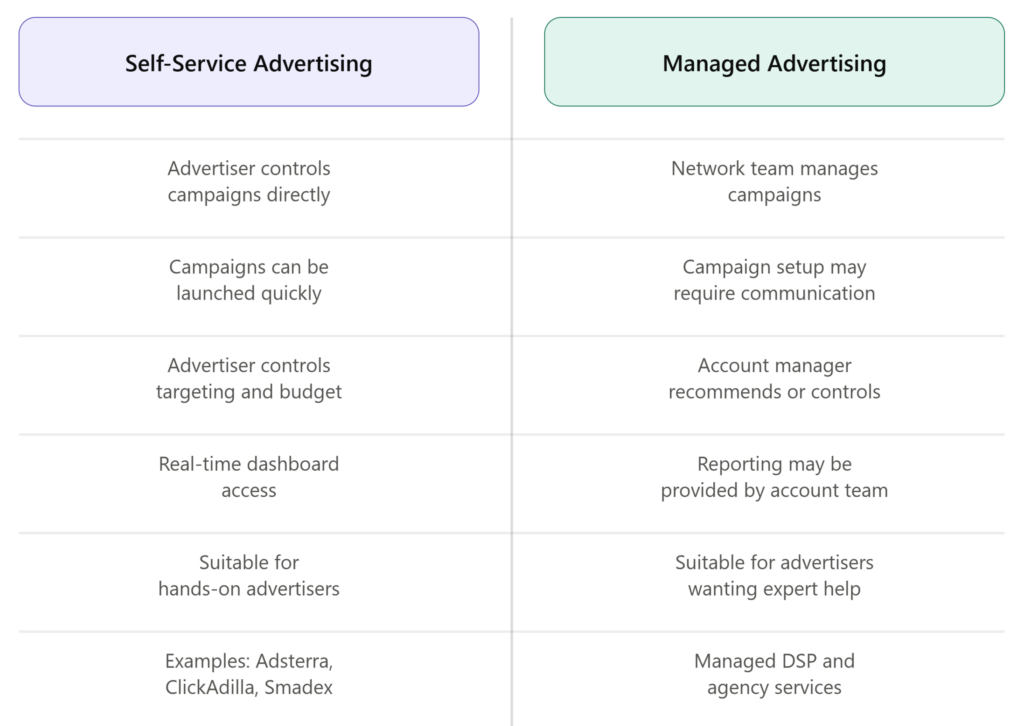
A self-service advertising network gives advertisers direct control over campaign creation, targeting, bidding, budgets, creatives, and optimization.
A managed advertising service, on the other hand, provides an account manager or advertising team that handles some or most of the campaign operations.
How to Choose the Right Self-Service Advertising Network
Choosing the right self-service advertising network depends on your goals, budget, traffic type, and level of experience. Since each platform offers different features, ad formats, and targeting capabilities, it’s important to select one that aligns with your campaign objectives and monetization strategy.
- Define your goal: Decide whether you want conversions, traffic, app installs, or brand awareness before selecting a network.
- Match ad formats to your strategy: Choose platforms that support formats like push, pop, native, display, or video based on your campaign type.
- Check targeting options: Look for advanced targeting such as GEO, device, OS, audience segments, and placements to reach the right users.
- Evaluate traffic quality: Ensure the network provides high-quality, fraud-filtered traffic with good engagement and conversion rates.
- Analyze pricing models: Compare CPC, CPM, CPA, or Smart bidding options to find what fits your budget and ROI goals.
- Review optimization tools: Prefer platforms with AI optimization, automated bidding, and real-time analytics for better performance.
- Consider minimum deposit: Choose a network that fits your budget, especially if you are just starting out.
- Check scalability: Make sure the platform allows you to scale campaigns easily across multiple GEOs and formats.
- Assess ease of use: A clean dashboard and simple setup can save time and reduce complexity, especially for beginners.
- Look at support and reputation: Reliable documentation, support, and positive reviews indicate a trustworthy platform.
By focusing on these factors, you can choose a self-service ad network that not only fits your current needs but also helps you scale campaigns efficiently and maximize ROI over time.
Final Thoughts
The best self-service ad network in 2026 depends on your campaign objective, audience, ad format, budget, and level of experience. In this article, we reviewed top platforms including PropellerAds, Adsterra, Clickadu, ROI Ads, AdsCompass, ClickAdilla, RichAds, AdMaven, HilltopAds, RollerAds, SmartyAds, and AdLib DSP. Each of these networks offers different strengths, from high-volume performance traffic and push monetization to advanced programmatic capabilities and AI-driven optimization. While platforms like PropellerAds, Adsterra, and Clickadu are strong all-round choices, others such as ClickAdilla, AdsCompass, and RichAds are more suitable for performance marketers and affiliates, while SmartyAds and AdLib DSP cater to advanced programmatic needs.
Self-service advertising continues to grow because it gives advertisers full control over targeting, bidding, and optimization without relying on intermediaries. However, choosing a platform based only on traffic volume or low CPC is a mistake. Factors such as traffic quality, targeting accuracy, conversion rate, CPA, ROAS, reporting transparency, and brand safety are far more important for long-term success. The most effective strategy is to test multiple networks with controlled budgets, compare performance using consistent metrics, and scale the platform that delivers the best results. In self-service advertising, performance is driven by testing, data, and optimization, making it one of the most powerful ways to scale campaigns efficiently.
Frequently Asked Questions (FAQs)
What Is a Self-Service Advertising Network?
A self-service advertising network is a platform that allows advertisers to create, manage, and optimize campaigns directly through a dashboard. Users can control budgets, bids, targeting, creatives, and performance tracking without relying on a sales representative or account manager.
Which Self-Service Advertising Network Is Best in 2026?
There is no single “best” network for everyone, but platforms like PropellerAds, Adsterra, and Clickadu are considered top all-round choices due to their strong advertiser demand, multiple ad formats, and global traffic coverage. For performance-focused campaigns, networks such as ClickAdilla, AdsCompass, and RichAds are often preferred, while SmartyAds and AdLib DSP are better suited for advanced programmatic campaigns.
What Is the Cheapest Self-Service Ad Network?
There is no single cheapest platform because costs depend on GEO, ad format, and competition. However, networks like ClickAdilla and PropellerAds are known for low entry budgets and flexible campaign testing options, making them suitable for beginners and small advertisers.
Are Self-Service Ad Networks Good for Publishers?
Yes. Self-service networks benefit publishers by increasing advertiser competition, improving fill rates, and boosting revenue potential. Platforms such as Adsterra, AdMaven, and HilltopAds are widely used for website monetization across global traffic sources.
Which Self-Service Ad Network Is Best for Beginners?
Beginner-friendly networks include AdMaven, PropellerAds, and ROIads, as they offer simple dashboards, lower minimum deposits, and easy ad setup. However, beginners should still understand basic concepts like targeting, bidding, and conversion tracking.
Which Ad Formats Are Available on Self-Service Networks?
Most self-service ad networks support multiple formats, including push notifications, popunder ads, native ads, display banners, video ads, in-page push, interstitials, and direct-link campaigns. The available formats vary by platform and traffic type.
How Much Budget Do I Need to Start?
The starting budget depends on the network and campaign type. Some platforms allow campaigns with small deposits, while others require larger testing budgets. For meaningful results, advertisers should start with enough budget to collect reliable performance data instead of choosing the lowest possible amount.
Do Self-Service Ad Networks Require Approval?
Yes, most networks review accounts, traffic sources, or ad placements before activation. Platforms like HilltopAds and RichAds may also evaluate traffic quality to ensure compliance with advertiser standards.
Should I Use One Network or Multiple?
Using multiple networks is often the best strategy. Traffic quality, CPM rates, and conversion performance can vary between platforms. Testing networks like Adsterra, Clickadu, and AdsCompass together allows advertisers to compare results and scale the best-performing option.
Which self-service ad network pays publishers the most?
Earnings vary based on traffic quality and GEO, but networks like PropellerAds, Adsterra, and HilltopAds are known for competitive CPM rates and high global demand.
Are self-service ad networks safe to use?
Yes, most reputable platforms include fraud prevention, traffic filtering, and brand safety controls. However, advertisers and publishers should always monitor performance and ensure compliance with platform policies.
How do I choose the best self-service ad network?
Choose a network based on your campaign goals, audience, ad formats, and budget. Test multiple platforms, analyze metrics like CTR, CPA, and ROAS, and scale the network that delivers consistent and profitable results.