


The best ad networks for bloggers in 2026 include platforms like Google AdSense, Ezoic, Mediavine, Raptive, Monumetric, and Adsterra, depending on your traffic level, audience quality, and monetization goals. Beginners can start with AdSense or Ezoic, while high-traffic blogs can generate higher revenue with premium networks like Mediavine and Raptive.
Choosing the best ad networks for bloggers in 2026 is one of the most important decisions for increasing blog revenue. Not all ad networks perform the same, and the right platform depends on factors like traffic volume, audience location, niche, and content quality.
Some networks are designed for beginners with low traffic, while others focus on high-quality publishers and offer premium RPMs. In this guide, we have carefully selected and analyzed the top ad networks for bloggers based on real publisher requirements, monetization potential, approval difficulty, and overall performance to help you choose the best option for your blog.



What Is an Ad Network?
An ad network is a platform that connects advertisers with publishers that have advertising inventory available on their websites. The network helps sell that inventory and delivers advertisements to visitors based on factors such as audience, content, location, device, advertiser demand, and available targeting signals.
A blogger places advertising code, tags, or an integration on their website. When a visitor views or interacts with an advertisement, the publisher can earn revenue depending on the network’s pricing model.
A simplified advertising relationship looks like this:
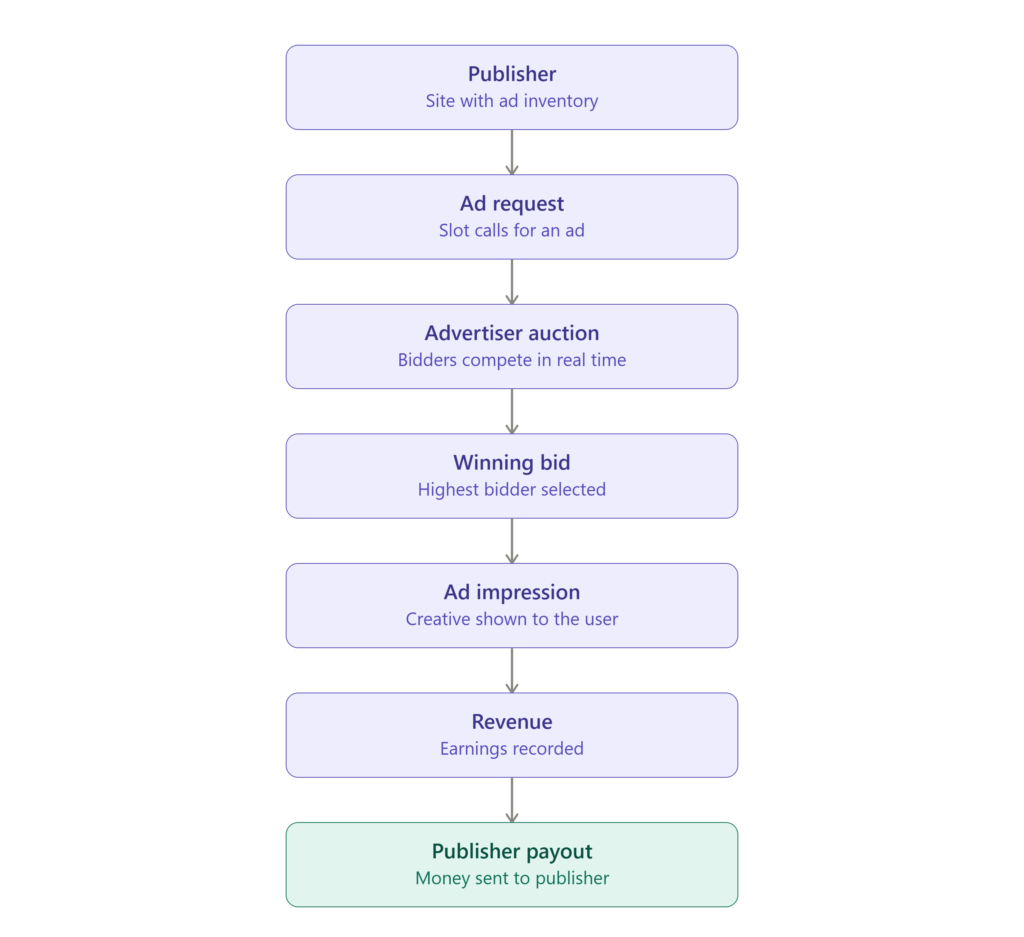
Ad networks can use different payment models, including CPM, CPC, CPA, and revenue-share arrangements. The actual amount a blogger earns depends on traffic volume, audience geography, niche, ad placement, device mix, seasonality, advertiser demand, and user engagement.
How Do Ad Networks Work for Bloggers?
The basic process consists of six stages.
1. Publisher registration
You create an account and provide information about your website, content, audience, traffic sources, and advertising goals.
2. Website review
Depending on the network, your site may be reviewed for content quality, traffic, brand safety, technical setup, and compliance with advertising policies.
3. Ad setup
Once approved, the platform provides ad code, plugins, header-bidding integrations, tags, or another implementation method.
4. Ad serving
The network connects your available ad space with advertiser demand and displays suitable advertisements to visitors.
5. Revenue tracking
The platform records impressions, clicks, viewability, conversions, RPM, CPM, or other relevant performance metrics.
6. Publisher payment
After earnings are finalized and the applicable payment threshold is reached, the network sends your revenue according to its payment schedule and selected payment method.
The last stage is important. Estimated revenue is not always the same as finalized revenue. Invalid traffic, advertiser adjustments, refunds, discrepancies, policy violations, and other factors can affect the amount ultimately paid.
How We Picked the Best Ad Networks for Bloggers
We evaluated each ad network based on the factors that matter most to bloggers when choosing a monetization platform. Instead of ranking networks only by advertised CPMs or claims about high earnings, we considered their overall suitability, accessibility, publisher experience, ad formats, payment terms, and monetization potential.
Our evaluation focused on:
- Ad Revenue Potential: Ability to monetize impressions, clicks, or other valuable actions.
- Ad Formats: Availability of display, native, video, push, in-page, sticky, or other formats.
- Publisher Requirements: Traffic, content, geographic, and quality requirements.
- Payment Terms: Minimum payout, payment frequency, and available payment methods.
- Global Availability: Support for bloggers and audiences across different countries.
- Optimization: Automated testing, header bidding, AI optimization, or revenue-management tools.
- Ad Quality: Brand safety, advertiser quality, and control over inappropriate advertisements.
- Reporting: RPM, CPM, impressions, clicks, earnings, and performance analytics.
- Ease of Use: Simplicity of installation and day-to-day management.
- Publisher Support: Documentation, account managers, technical assistance, and support resources.
We also considered who each network is actually best for because the ideal solution for a new blogger may be very different from the best platform for a website receiving hundreds of thousands of monthly pageviews.
Top 20 Best Ad Networks for Bloggers in 2026
Below is a detailed review of the best ad networks for bloggers in 2026:
- Google AdSense
- Ezoic
- Media.net
- Infolinks
- PropellerAds
- Adsterra
- Revcontent
- Monumetric
- Outbrain
- SHE Media
- AdPushup
- Sovrn
- Setupad
- NitroPay
- Playwire
- Mediavine
- Raptive
- Publift
- Taboola
- AdThrive
1. Google AdSense — Best Overall Ad Network for Bloggers
Company Overview
| Features | Details |
|---|---|
| Founded | 2003 |
| Headquarters | United States |
| Ad Formats | Display, In-Article, In-Feed, Matched Content, Auto Ads |
| Commission Type | CPC, CPM |
| Minimum Payment | $100 |
| Payment Frequency | Monthly |
| Payment Methods | Bank Transfer (EFT), Wire Transfer |
Google AdSense is one of the most popular ad networks for bloggers and is often the first step into website monetization. It allows you to earn money by displaying ads that match your content and audience using Google’s massive advertiser network. With features like Auto Ads, AdSense automatically places ads on your blog for the best performance, so you don’t need technical skills to get started. It supports formats like display, in-article, in-feed, and multiplex ads, making it suitable for almost every type of blog.
AdSense is best for beginners and growing bloggers who want a simple, reliable way to monetize traffic. It offers consistent payments, strong fill rates, and works in almost every niche. While earnings (RPM) may be lower compared to premium networks, it is highly stable and easy to scale as your traffic grows. Many bloggers also use AdSense alongside other monetization methods to increase overall revenue without affecting user experience.
Requirements for Publishers
- Website ownership: Publishers must own a website or have full control over content and ad placement.
- Original content: Websites must provide unique, valuable, and user-focused content with no plagiarism or thin pages.
- Policy compliance: Publishers must follow Google Publisher Policies, including restrictions on invalid traffic and prohibited content.
- Traffic quality: Traffic must be real and not generated through bots, paid-to-click, or misleading sources.
- Ad placement rules: Ads must be implemented correctly without encouraging clicks or misleading users.
2. Ezoic
Company Overview
| Features | Details |
|---|---|
| Founded | 2010 |
| Headquarters | United States |
| Ad Formats | Display, Native, Video, Interstitial, Auto Ads |
| Commission Type | CPM (Revenue Share) |
| Minimum Payment | $20 |
| Payment Frequency | Monthly |
| Payment Methods | PayPal, Payoneer, Direct Deposit, Wire Transfer |
Ezoic is an AI-powered ad platform designed to help bloggers increase their ad revenue through automated testing and optimization. Instead of just showing ads, Ezoic uses machine learning to test different layouts, ad placements, and user experiences to find what generates the highest earnings. It supports display, video, and native ads, and integrates easily with platforms like Google AdSense, making it a strong upgrade for bloggers ready to grow.
Ezoic is best for bloggers who already have some traffic and want to improve their revenue without manually managing ads. It offers detailed analytics, site speed optimization, and revenue tracking tools that help you understand what works best for your audience. While setup can be slightly technical compared to AdSense, the earning potential is usually higher, making it a popular choice for bloggers looking to scale their income with data-driven optimization.
Requirements for Publishers
- Website and traffic: Publishers must submit a website with sufficient traffic and connect analytics for verification.
- Content quality: Websites must contain original, high-quality content aligned with advertiser standards.
- Policy compliance: Sites must comply with Google policies, including restrictions on invalid traffic and prohibited content.
- Technical integration: Publishers must integrate Ezoic via JavaScript or plugin and configure ads.txt correctly.
- User experience: Websites must provide proper navigation, structure, and a good overall user experience.
3. Media.net
Company Overview
| Features | Details |
|---|---|
| Founded | 2010 |
| Headquarters | United States |
| Ad Formats | Contextual Display, Native, In-Content Ads |
| Commission Type | CPC, CPM |
| Minimum Payment | $100 |
| Payment Frequency | Monthly |
| Payment Methods | Payoneer, Wire Transfer |
Media.net is one of the largest contextual ad networks and a strong alternative to Google AdSense for bloggers. Powered by Yahoo and Bing demand, it focuses on showing ads based on the meaning of your content rather than just keywords. This helps display highly relevant ads, especially on blogs related to finance, technology, business, and education. It supports display and native-style ads that blend well with blog content.
Media.net is best for bloggers with quality content and traffic from Tier-1 countries like the US, UK, and Canada. It usually offers higher earnings (CPM) than AdSense in high-value niches, but approval is more selective and requires good content quality. For bloggers who meet the requirements, Media.net can significantly increase revenue, especially when used alongside other monetization strategies.
Requirements for Publishers
- Website ownership: Publishers must own the site or have a direct contractual right to monetize it through Media.net.
- Original content: Websites must contain original, high-quality content and cannot rely on copied, thin, or ad-heavy pages.
- Traffic quality: Traffic must be legitimate and primarily organic, with no incentivized clicks, bots, or artificial traffic sources.
- Technical compliance: Publishers must implement ads.txt/app-ads.txt and provide accurate site and inventory data.
- Policy compliance: Sites must follow strict content, ad placement, and prohibited content policies, including restrictions on illegal or harmful content.
4. Infolinks
Company Overview
| Features | Details |
|---|---|
| Founded | 2007 |
| Headquarters | Israel |
| Ad Formats | In-Text, In-Frame, In-Article, In-Fold, In-Screen Ads |
| Commission Type | CPC, CPM |
| Minimum Payment | $50 |
| Payment Frequency | Monthly |
| Payment Methods | PayPal, Payoneer, Bank Transfer, Western Union |
Infolinks is a popular ad network for bloggers that focuses on in-text and contextual advertising. Instead of using traditional banner ads, it turns keywords within your blog content into clickable ads, along with formats like in-fold, in-frame, and in-tag ads. This makes it less intrusive and allows bloggers to monetize content without affecting the overall design of their website. Setup is simple and only requires adding a small script to your site.
Infolinks is best for beginner bloggers or sites with low to medium traffic who want an easy way to start earning. It has no strict traffic requirements and works well alongside other ad networks like Google AdSense, helping increase total revenue. While earnings may be lower compared to premium platforms, it is a reliable option for adding an extra income layer without harming user experience.
Requirements for Publishers
- Website ownership: Publishers must own the website or have legal authorization to monetize it using Infolinks ad code and services.
- Original content: Websites must contain original, high-quality content and must not include copied, misleading, or low-value pages.
- Traffic quality: Traffic must be genuine and human-driven, with no bots, incentivized clicks, or artificial traffic generation methods.
- Account approval: All websites are reviewed by the Infolinks quality team, and approval is required before ads can be activated.
- Policy compliance: Websites must not contain illegal, offensive, or harmful content and must follow Infolinks content and advertising policies.
5. PropellerAds
Company Overview
| Features | Details |
|---|---|
| Founded | 2011 |
| Headquarters | Cyprus |
| Ad Formats | Push Notifications, In-Page Push, Popunder, Interstitial, Native, Direct Link |
| Commission Type | CPM, CPC, CPA |
| Minimum Payment | From $5 (depends on payment method) |
| Payment Frequency | Weekly |
| Payment Methods | PayPal, Payoneer, Skrill, WebMoney, Wire Transfer, Bank Cards, Cryptocurrency |
PropellerAds is a popular ad network for bloggers that offers multiple ad formats including push notifications, popunder, native, and interstitial ads. It provides a self-service platform where bloggers can easily monetize their traffic without complex setup. With access to a large global advertiser base, PropellerAds delivers high fill rates and works well across different niches, even for blogs with non-Tier-1 traffic.
PropellerAds is best for bloggers who want higher earning potential beyond traditional display ads. It offers fast approval, low entry requirements, and automated optimization tools like smart bidding and AI-based targeting to improve revenue. While some ad formats like pop-ups or push can be more aggressive, when used properly they can significantly boost overall blog income, especially for medium- to high-traffic websites.
Requirements for Publishers
- Website or traffic source: Publishers must own a website, app, or valid traffic source and have full rights to monetize that inventory through the platform.
- Account approval: Publishers must register an account, and approval is granted after a review process at the platform’s discretion.
- Traffic quality: Traffic must be real and human-driven, with no bots, auto-redirects, cloaking, or fraudulent engagement methods.
- Ad implementation compliance: Publishers must correctly integrate ad formats and avoid deceptive practices such as forced clicks, hidden ads, or auto-download behavior.
- Policy compliance: Publishers must follow strict content and safety policies, including restrictions on malware, misleading content, and prohibited or illegal material.
6. Adsterra
Company Overview
| Features | Details |
|---|---|
| Founded | 2013 |
| Headquarters | Limassol, Cyprus |
| Ad Formats | Popunder, Social Bar, In-Page Push, Native, Display, Interstitial, Direct Link |
| Commission Type | CPM, CPC, CPA |
| Minimum Payment | From $5 (depends on payment method) |
| Payment Frequency | Bi-weekly (Net-15) |
| Payment Methods | PayPal, Paxum, WebMoney, Wire Transfer, Cryptocurrency, Bank Cards |
Adsterra is a flexible ad network for bloggers that offers multiple monetization formats, including Social Bar, push notifications, popunder, native, and display ads. It allows bloggers to monetize traffic easily through a simple setup, with global advertiser demand that works well across both Tier-1 and Tier-2 countries. Its Social Bar format is especially popular because it appears inside content in a user-friendly way, helping improve engagement without relying only on traditional banners.
Adsterra is best for bloggers who want higher earnings and more control over their monetization strategy. It provides fast approval, low minimum payout options, and advanced targeting with real-time tracking to optimize performance. While some ad formats can be more aggressive, bloggers can choose placements that fit their audience, making it a strong option for scaling revenue, especially for sites with diverse or international traffic.
Requirements for Publishers
- Website or traffic source: Publishers must own a website, app, or valid traffic source (including social traffic) and have full rights to monetize that inventory.
- Account approval: Publishers must register an account, verify their email, and submit their website or traffic source for moderation before activation.
- Traffic quality: Traffic must be real and human-driven, with no bots, incentivized clicks, auto-redirects, or artificially generated engagement.
- Ad implementation compliance: Publishers must correctly place ad codes or Smartlink formats and avoid deceptive practices such as forced clicks, hidden ads, or auto-download behavior.
- Policy compliance: Publishers must follow strict content and safety policies, including restrictions on malware, illegal content, phishing, and other harmful activities.
7. Revcontent
Company Overview
| Features | Details |
|---|---|
| Founded | 2013 |
| Headquarters | United States |
| Ad Formats | Native Ads, Content Recommendation Widgets, In-Feed Ads |
| Commission Type | CPC, CPM |
| Minimum Payment | $50 |
| Payment Frequency | Monthly |
| Payment Methods | PayPal, Wire Transfer |
Revcontent is a premium native ad network that helps bloggers monetize their content through recommendation widgets placed below or within articles. These ads match the look and feel of your website, making them less intrusive and more engaging for users. With access to high-quality advertisers and strong demand, Revcontent focuses on delivering relevant content recommendations that improve click-through rates and overall revenue.
Revcontent is best for established bloggers with consistent traffic who want higher earnings from native advertising. It offers advanced targeting, real-time analytics, and strong control over ad quality to maintain a good user experience. While approval is more selective compared to beginner networks, bloggers who qualify can earn higher RPMs, especially in niches like news, entertainment, and viral content.
Requirements for Publishers
- Website ownership: Publishers must own the website or have full legal rights to monetize it and participate in the Revcontent program.
- Account approval: All websites and domains must be submitted for manual review, and approval is granted only after evaluation by the Revcontent team.
- Content quality: Websites must provide original, high-quality, and brand-safe content, avoiding misleading, false, or low-value material.
- Traffic quality: Traffic must be genuine and compliant, with no fraud, bots, or artificially generated impressions or clicks.
- Technical and policy compliance: Publishers must correctly implement widgets, maintain privacy policies, disclose sponsored content, and follow all Revcontent advertising and data policies.
8. Monumetric
Company Overview
| Features | Details |
|---|---|
| Founded | 2012 |
| Headquarters | United States |
| Ad Formats | Display, Native, Video |
| Commission Type | CPM (Revenue Share) |
| Minimum Payment | $10 |
| Payment Frequency | Monthly |
| Payment Methods | PayPal, Direct Deposit |
Monumetric is a managed ad network designed to help bloggers increase their revenue through optimized display advertising. It focuses on improving user experience while maximizing earnings by placing ads strategically across your site. Monumetric offers formats like display, video, and native ads, and uses data-driven optimization to improve RPM and overall performance.
Monumetric is best for bloggers with growing traffic who want a balance between revenue and user experience. It requires a minimum traffic threshold for approval, but in return provides better ad quality, higher payouts, and dedicated support. For bloggers moving beyond basic networks like AdSense, Monumetric is a strong option to scale revenue with more control and professional optimization.
Requirements for Publishers
- Traffic requirement: Publishers must have a minimum of around 10,000 monthly pageviews to join entry-level programs like Propel.
- Website ownership: Publishers must own and manage a content-based website with full access to implement ads and monetization settings.
- Content quality: Websites must publish original, high-quality, and advertiser-friendly content suitable for brand-safe advertising demand.
- Technical integration: Publishers must allow Monumetric to install ad tags, optimize placements, and configure ads.txt or related monetization settings.
- Policy and partnership compliance: Publishers must follow advertising standards, maintain professional communication, and comply with platform policies and advertiser expectations.
9. Outbrain
Company Overview
| Features | Details |
|---|---|
| Founded | 2006 |
| Headquarters | United States |
| Ad Formats | Native Ads, Content Recommendation Widgets, In-Feed Ads |
| Commission Type | CPC, CPM |
| Minimum Payment | $50 |
| Payment Frequency | Monthly |
| Payment Methods | PayPal, Wire Transfer |
Outbrain is a leading native ad network that helps bloggers monetize their content through recommendation widgets placed within or below articles. These ads are designed to match your site’s content and layout, making them feel more natural and less disruptive than traditional banners. With access to premium advertisers and large global demand, Outbrain focuses on delivering high-quality, content-driven ads that improve engagement and click-through rates.
Outbrain is best for bloggers with high-quality content and consistent traffic who want to earn through native advertising. It offers advanced targeting, strong brand-safe campaigns, and detailed analytics to optimize performance. While approval is more selective compared to beginner networks, bloggers who qualify can benefit from higher RPMs and better user experience, especially in niches like news, lifestyle, and editorial content.
Requirements for Publishers
- Website ownership: Publishers must own or operate the website or have exclusive rights to monetize the inventory where Outbrain widgets are installed.
- Account and domain approval: All websites must be submitted for manual review and approved before widgets can go live on the platform.
- Content quality: Websites must provide original, high-quality, and brand-safe editorial content, avoiding low-value or “made-for-ads” pages.
- Traffic quality: Traffic must be legitimate and human-driven, with no bots, incentivized clicks, artificial engagement, or invalid activity.
- Technical and policy compliance: Publishers must implement ads.txt, maintain privacy and consent mechanisms, clearly label ads as sponsored, and follow strict placement and UX guidelines.
10. SHE Media
Company Overview
| Features | Details |
|---|---|
| Founded | 1999 |
| Headquarters | United States |
| Ad Formats | Display, Native, Video, Sponsored Content |
| Commission Type | CPM (Revenue Share) |
| Minimum Payment | $100 |
| Payment Frequency | Monthly |
| Payment Methods | Direct Deposit, Check |
SHE Media is a premium ad network and media platform focused on lifestyle, parenting, wellness, and female-focused content. It helps bloggers monetize their websites through high-quality display, native, and branded content campaigns. With direct advertiser relationships and curated demand, SHE Media focuses on delivering brand-safe ads that match the tone and audience of your blog.
SHE Media is best for established bloggers with niche audiences, especially in lifestyle and women-focused categories. It offers higher-quality ads, better user experience, and access to premium brand partnerships that can increase overall earnings. While approval is selective and requires consistent traffic, bloggers who qualify can benefit from strong CPMs and long-term monetization opportunities.
Requirements for Publishers
- Traffic requirement: Publishers should have around 50,000+ monthly pageviews, although sites with strong content and growth potential may be reviewed case-by-case.
- Website ownership: Publishers must own and operate a blog or website that can support third-party advertising and monetization integrations.
- Content quality: Websites must consistently publish original, high-quality, and brand-safe content with clear editorial value and audience engagement.
- Traffic and audience quality: Sites should have authentic traffic, strong engagement, and typically include a significant portion of Tier 1 audience (e.g., US traffic).
- Technical and policy compliance: Publishers must support ads.txt, comply with privacy laws (GDPR/CCPA), allow ad inventory exclusivity, and follow strict content and advertiser safety guidelines.
11. AdPushup
Company Overview
| Features | Details |
|---|---|
| Founded | 2014 |
| Headquarters | United States |
| Ad Formats | Display, Native, Sticky Ads, Video, AMP Ads |
| Commission Type | CPM (Revenue Share) |
| Minimum Payment | $50 |
| Payment Frequency | Monthly |
| Payment Methods | PayPal, Wire Transfer |
AdPushup is an advanced ad revenue optimization platform that helps bloggers increase earnings through data-driven testing and header bidding technology. Instead of just placing ads, it uses A/B testing, layout optimization, and multiple demand partners to find the best-performing ad placements on your blog. It supports display, native, and sticky ads, and integrates with networks like Google AdSense and premium ad exchanges to maximize revenue.
AdPushup is best for bloggers with steady traffic who want to significantly boost their ad income without manually optimizing everything. It offers detailed analytics, automated optimization, and improved CPMs by connecting your site to multiple bidders at once. While it requires a minimum traffic level for approval, bloggers who qualify can see a strong increase in revenue while maintaining a good user experience.
Requirements for Publishers
- Traffic requirement: Publishers typically need moderate to high traffic (around 50,000+ monthly pageviews or more) to benefit from AdPushup’s optimization platform.
- Website ownership: Publishers must own and control their website and ad inventory, with full access to implement scripts and make monetization changes.
- Content quality: Websites must publish original, high-quality, and advertiser-safe content that complies with Google AdSense and Ad Exchange policies.
- Technical integration: Publishers must integrate AdPushup scripts, enable A/B testing, and allow optimization features such as header bidding and layout experimentation.
- Policy compliance: Websites must remain in good standing with Google policies, including restrictions on invalid traffic, misleading layouts, and prohibited content.
12. Sovrn
Company Overview
| Features | Details |
|---|---|
| Founded | 2014 |
| Headquarters | United States |
| Ad Formats | Display, Native, Video, Commerce (Affiliate Links via Sovrn Commerce) |
| Commission Type | CPM (Revenue Share), CPC (Commerce) |
| Minimum Payment | $25 |
| Payment Frequency | Monthly |
| Payment Methods | PayPal, ACH (Direct Deposit), Wire Transfer |
Sovrn is a popular monetization platform for bloggers that combines display advertising with affiliate-driven revenue through its Sovrn Commerce solution. It automatically converts product mentions in your blog content into affiliate links, allowing you to earn commissions when users make purchases. Along with this, it also offers display and native ads, making it a flexible option for content-based websites.
Sovrn is best for bloggers who create product reviews, comparisons, or editorial content with brand mentions. It requires minimal setup and works in the background to monetize existing content without affecting user experience. With a low payout threshold and access to thousands of merchants, it is a strong choice for bloggers looking to combine ad revenue with affiliate earnings and increase overall monetization.
Requirements for Publishers
- Website ownership: Publishers must own the domain or have full authorization to monetize the inventory submitted to Sovrn.
- Traffic requirement: Websites typically need ~100,000+ monthly visits with consistent, engaged, and observable traffic for approval.
- Content quality: Sites must publish original, regularly updated, and brand-safe content, with no copyrighted, misleading, or unsafe material.
- Technical integration: Publishers must implement and maintain an accurate ads.txt file, provide correct domain data, and allow inventory verification for programmatic demand.
- Traffic and policy compliance: Traffic must be organic and human-driven, with no bots, incentivized clicks, pop-based traffic, or artificial engagement, and must comply with strict supply policies.
13. Setupad
Company Overview
| Features | Details |
|---|---|
| Founded | 2015 |
| Headquarters | Latvia |
| Ad Formats | Display, Native, Video, Sticky Ads |
| Commission Type | CPM (Revenue Share) |
| Minimum Payment | €100 |
| Payment Frequency | Monthly |
| Payment Methods | PayPal, Wire Transfer |
Setupad is a premium ad monetization platform that helps bloggers increase revenue using header bidding technology. It connects your website to multiple demand partners and ad exchanges, allowing advertisers to compete for your ad space in real time. This competition often results in higher CPMs compared to traditional ad networks. Setupad mainly focuses on display and programmatic ads, making it a strong choice for content-driven blogs.
Setupad is best for bloggers with steady traffic who want to maximize earnings through programmatic advertising. It offers advanced optimization, real-time analytics, and better control over ad performance while maintaining a good user experience. Although it requires a minimum traffic threshold for approval, bloggers who qualify can significantly increase their ad revenue by accessing premium demand and higher-paying advertisers.
Requirements for Publishers
- Traffic requirement: Publishers typically need ~100,000+ monthly visitors, with consistent and high-quality traffic, to qualify for Setupad’s monetization solutions.
- Website ownership: Publishers must own and control their website and ad inventory, with access to Google Ad Manager (GAM) or the ability to integrate programmatic ad setups.
- Content quality: Websites must publish original, brand-safe, and advertiser-friendly content, avoiding prohibited or low-quality material.
- Technical integration: Publishers must implement ads.txt, integrate header bidding or Prebid solutions, and complete setup steps such as ad code placement and Google publisher verification.
- Traffic and policy compliance: Traffic must be genuine and compliant, and publishers must follow programmatic advertising standards, including privacy laws and invalid traffic restrictions.
14. NitroPay
Company Overview
| Features | Details |
|---|---|
| Founded | 2017 |
| Headquarters | United States |
| Ad Formats | Display, Video, Native, Rewarded Ads |
| Commission Type | CPM (Revenue Share) |
| Minimum Payment | $100 |
| Payment Frequency | Net-30 (Monthly cycle) |
| Payment Methods | PayPal, ACH (Direct Deposit), Wire Transfer |
NitroPay is a premium ad network designed to help bloggers maximize revenue through high-quality display and video advertising. It connects your site with multiple demand partners and programmatic exchanges, using header bidding to increase competition for your ad space. This results in higher CPMs and better overall earnings compared to basic ad networks, while maintaining a clean and user-friendly experience.
NitroPay is best for bloggers with growing to high traffic who want to scale their ad revenue with better optimization. It offers advanced analytics, real-time performance tracking, and support for improving site monetization strategy. While it has stricter approval requirements than beginner networks, bloggers who qualify can benefit from higher payouts, premium ads, and improved long-term revenue performance.
Requirements for Publishers
- Website ownership: Publishers must own and operate a content-based website and have full rights to monetize their inventory through NitroPay.
- Account and site approval: Each website is manually reviewed based on traffic volume, GEO distribution, and content quality before acceptance.
- Content quality: Websites must provide original, fully functional, and content-driven pages, and cannot be created primarily for ads or low-value monetization.
- Traffic quality: Traffic must be genuine and human-driven, with strict restrictions on bots, invalid traffic, incentivized clicks, or artificial engagement.
- Technical and policy compliance: Publishers must implement ad scripts, maintain ads.txt and privacy disclosures, and comply with data protection laws and advertising standards.
15. Playwire
Company Overview
| Features | Details |
|---|---|
| Founded | 2015 |
| Headquarters | United States |
| Ad Formats | Display, Video, Native, High-Impact Ads |
| Commission Type | CPM (Revenue Share) |
| Minimum Payment | $100 |
| Payment Frequency | Monthly |
| Payment Methods | PayPal, Wire Transfer |
Playwire is a premium ad network that helps bloggers maximize revenue through programmatic advertising and advanced ad optimization. It connects your website to multiple demand partners using header bidding, allowing advertisers to compete for your ad space in real time. Playwire supports display, video, and native ads, and focuses on improving both revenue and user experience with optimized ad placements.
Playwire is best for bloggers with growing to high traffic who want to scale their monetization with better performance and premium demand. It offers detailed analytics, real-time reporting, and access to high-quality advertisers, which can significantly increase CPMs compared to basic ad networks. While it requires a minimum traffic level for approval, bloggers who qualify can benefit from higher earnings, better ad quality, and long-term revenue growth.
Requirements for Publishers
- Traffic requirement: Publishers typically need 500,000+ monthly pageviews (recommended minimum ~100K+ to apply, but higher traffic improves approval chances).
- Website ownership: Publishers must own and control their website or app and provide full access, including Google Analytics for traffic verification.
- Content quality: Websites must publish original, high-quality, and advertiser-friendly content and must not be blacklisted by Google or other ad providers.
- Technical integration: Publishers must implement ads.txt, consent management (GDPR/CCPA), and Playwire ad scripts, and allow full monetization setup via their platform.
- Traffic and policy compliance: Traffic must be legitimate and measurable, with no bots, incentivized clicks, or fraudulent activity, and must comply with strict brand safety and content policies.
16. Mediavine
Company Overview
| Features | Details |
|---|---|
| Founded | 2004 |
| Headquarters | United States |
| Ad Formats | Display, Video, Native, Sponsored Content |
| Commission Type | CPM (Revenue Share) |
| Minimum Payment | $25 |
| Payment Frequency | Monthly |
| Payment Methods | PayPal, Direct Deposit (ACH), Wire Transfer |
Mediavine is a premium ad network designed for bloggers who want to maximize revenue through high-quality display and video advertising. It uses advanced ad optimization and header bidding technology to connect your site with top-tier advertisers, ensuring higher CPMs and better overall earnings. Mediavine focuses strongly on user experience, placing ads strategically so they generate revenue without negatively impacting site speed or engagement.
Mediavine is best for established bloggers with consistent traffic, especially those with strong Tier-1 audiences like the US, UK, and Canada. It requires a minimum traffic threshold for approval, but in return offers premium ad demand, detailed analytics, and dedicated support. Bloggers who qualify often see significantly higher earnings compared to basic ad networks, making Mediavine one of the best options for scaling long-term blog monetization.
Requirements for Publishers
- Revenue requirement: Publishers must generate at least $5,000 in annual ad revenue to qualify for Mediavine’s main ad management program.
- Website ownership: Publishers must own and operate their website and have full control over content and monetization implementation.
- Content quality: Websites must publish original, audience-first, high-quality content and avoid low-value, scraped, or mass-produced pages.
- Traffic quality: Traffic must be clean, human, and brand-safe, with no bots, incentivized clicks, or invalid traffic sources.
- Policy and platform compliance: Publishers must be in good standing with Google AdSense/Ad Exchange and maintain a strong user experience that supports premium advertising.
17. Raptive
Company Overview
| Features | Details |
|---|---|
| Founded | 2013 |
| Headquarters | United States |
| Ad Formats | Display, Video, Native, Sponsored Content |
| Commission Type | CPM (Revenue Share) |
| Minimum Payment | $25 |
| Payment Frequency | Monthly |
| Payment Methods | Direct Deposit (ACH), Wire Transfer |
Raptive (formerly AdThrive) is a premium ad management platform that helps bloggers maximize revenue through high-quality display and video advertising. It uses advanced header bidding and direct advertiser relationships to deliver top-tier demand, resulting in higher CPMs compared to standard ad networks. Raptive also focuses heavily on site speed, user experience, and SEO-friendly ad placements, making it ideal for content-driven websites.
Raptive is best for established bloggers with high traffic, especially those with strong audiences from Tier-1 countries like the US. It has strict approval requirements, but in return offers some of the highest payouts in the industry, along with dedicated account support and advanced analytics. Bloggers who qualify often see significant revenue growth, making Raptive one of the best long-term monetization platforms for scaling blog income.
Requirements for Publishers
- Traffic requirement: Publishers must have at least 25,000 monthly pageviews, with higher traffic improving approval chances and access to advanced monetization features.
- Website ownership: Publishers must own and operate the website, with full control over content and the ability to implement ad code and monetization setup.
- Content quality: Websites must publish original, long-form, high-quality content with clear human involvement and strong editorial value.
- Traffic quality and GEO mix: Traffic must be real and compliant, with a significant portion coming from Tier 1 countries such as the US, UK, Canada, Australia, or New Zealand.
- Technical and policy compliance: Publishers must have Google Analytics properly configured, maintain ads.txt and privacy policies, ensure domain age (~6 months), and comply with strict advertising and brand safety standards.
18. Publift
Company Overview
| Features | Details |
|---|---|
| Founded | 2015 |
| Headquarters | Australia |
| Ad Formats | Display, Video, Native, Header Bidding |
| Commission Type | CPM (Revenue Share) |
| Minimum Payment | $50 |
| Payment Frequency | Monthly |
| Payment Methods | PayPal, Bank Transfer |
Publift is a premium ad monetization platform that helps bloggers increase revenue through programmatic advertising and header bidding technology. It connects your website to multiple demand partners and ad exchanges, allowing advertisers to compete for your ad inventory in real time. This competition helps improve CPM rates while maintaining a clean and optimized ad experience. Publift supports display, video, and native ads, making it suitable for content-focused blogs.
Publift is best for bloggers with steady to high traffic who want to maximize their ad revenue with advanced optimization. It offers detailed reporting, revenue analytics, and expert support to improve performance over time. While it requires a minimum traffic threshold for approval, bloggers who qualify can benefit from higher earnings, better ad quality, and scalable monetization through premium demand sources.
Requirements for Publishers
- Revenue requirement: Publishers typically need to generate at least $2,000+ monthly ad revenue to qualify for Publift’s managed monetization program.
- Website ownership: Publishers must own and control their website or app, with full access to ad inventory and monetization setup.
- Content quality: Websites must publish original, valuable, and brand-safe content, avoiding plagiarized, harmful, or low-quality pages.
- Traffic quality: Traffic must be consistent, genuine, and human-driven, with no bots, artificial spikes, or invalid activity.
- Technical and partnership compliance: Publishers must integrate Publift tags, allow optimization (header bidding, layout testing), and support long-term monetization collaboration.
19. Taboola
Company Overview
| Features | Details |
|---|---|
| Founded | 2007 |
| Headquarters | United States |
| Ad Formats | Native Ads, Content Recommendation Widgets, In-Feed Ads |
| Commission Type | CPC, CPM |
| Minimum Payment | $50 |
| Payment Frequency | Monthly |
| Payment Methods | PayPal, Wire Transfer |
Taboola is one of the leading native ad networks that helps bloggers monetize their content through recommendation widgets placed within or below articles. These ads are designed to match your site’s content and layout, making them feel like part of the user experience rather than traditional ads. With access to premium advertisers and partnerships with major publishers, Taboola delivers high-quality demand and strong engagement rates.
Taboola is best for bloggers with consistent traffic who want to earn through native advertising without hurting user experience. It offers advanced targeting, real-time analytics, and strong control over ad quality, helping maintain a professional look on your blog. While approval is selective and usually requires good traffic, bloggers who qualify can earn higher RPMs, especially in niches like news, lifestyle, and viral content.
Requirements for Publishers
- Website ownership: Publishers must own and operate their website(s) and have full rights to monetize the content and inventory submitted to the platform.
- Account and domain approval: All publishers must apply and pass a manual review process, where Taboola evaluates content quality, compliance, and eligibility before activation.
- Content quality: Websites must publish original, licensed, and brand-safe content, and cannot include fake news, copyrighted material, or harmful content.
- Technical integration: Publishers must implement Taboola widgets, maintain an ads.txt file, and declare Taboola as an authorized seller to ensure transparency and revenue eligibility.
- Traffic and policy compliance: Traffic must be genuine and human-driven, and publishers must avoid invalid traffic, misleading practices, and must comply with strict content, privacy, and advertising policies.
20. AdThrive
Company Overview
| Features | Details |
|---|---|
| Founded | 2013 |
| Headquarters | United States |
| Ad Formats | Display, Video, Native, Sponsored Content |
| Commission Type | CPM (Revenue Share) |
| Minimum Payment | $25 |
| Payment Frequency | Monthly |
| Payment Methods | Direct Deposit (ACH), Wire Transfer |
AdThrive is a premium ad network designed for high-traffic bloggers who want to maximize revenue through advanced display and video advertising. Now part of Raptive, AdThrive connects publishers with top-tier advertisers and uses header bidding technology to increase competition for ad space. This results in higher CPMs and better overall earnings compared to basic ad networks, while maintaining a strong focus on user experience and site performance.
AdThrive is best for established bloggers with significant traffic, especially those with audiences from Tier-1 countries like the US. It offers detailed analytics, dedicated account management, and premium brand demand, helping bloggers scale their revenue long term. While approval requirements are strict, bloggers who qualify can achieve some of the highest ad earnings in the industry with stable and optimized monetization.
Requirements for Publishers
- Traffic requirement: Publishers must have at least 25,000 monthly pageviews, with consistent and verifiable traffic before applying.
- Website ownership: Publishers must own and operate their website, with full control over content, monetization, and ad implementation.
- Content quality: Websites must publish original, high-quality, long-form content with clear human involvement and strong editorial value.
- Traffic quality and GEO mix: A significant portion of traffic must come from Tier 1 countries (US, UK, Canada, Australia, New Zealand), with strict quality and source verification.
- Technical and policy compliance: Publishers must have Google Analytics correctly configured, maintain ads.txt, ensure domain age (~6 months), and comply with strict brand safety and advertising policies.
Best Ad Networks for Bloggers – Quick Comparison Table
| Ad Network | Traffic Requirement | Approval Difficulty | Best For | Monetization Type |
|---|---|---|---|---|
| Google AdSense | None | Easy | Beginners | Display (CPC/CPM) |
| Ezoic | None–Low | Easy–Medium | Beginners → Scaling | AI Display (CPM) |
| Media.net | Low–Medium | Medium | Content blogs | Contextual (CPC) |
| Infolinks | None | Easy | Extra revenue | In-text / Display |
| PropellerAds | None | Easy | Global traffic | Push / Pop / CPM |
| Adsterra | None | Easy | Beginner + affiliates | Push / Pop / CPA |
| Revcontent | High | Hard | Premium blogs | Native (CPC/CPM) |
| Monumetric | 10K+ | Medium | Growing blogs | Display (CPM) |
| Outbrain | High | Hard | Large publishers | Native |
| SHE Media | 50K+ | Medium–Hard | Lifestyle blogs | Premium Display |
| AdPushup | 50K+ | Medium | Revenue optimization | Header bidding |
| Sovrn | 100K+ | Hard | Content publishers | Programmatic |
| Setupad | 100K+ | Hard | Advanced publishers | Header bidding |
| NitroPay | Medium–High | Medium | Gaming / communities | Programmatic |
| Playwire | 100K–500K+ | Hard | High traffic sites | Display + Video |
| Mediavine | $5K/year rev | Hard | Premium blogs | Managed Ads |
| Raptive | 25K+ | Hard | Tier 1 blogs | Premium Ads |
| Publift | $2K/month rev | Hard | High revenue sites | Programmatic |
| Taboola | High | Hard | News / viral blogs | Native Ads |
| AdThrive | 25K+ | Hard | Premium bloggers | Managed Ads |
Ad Networks Vs. Direct Advertising: What’s the Difference?
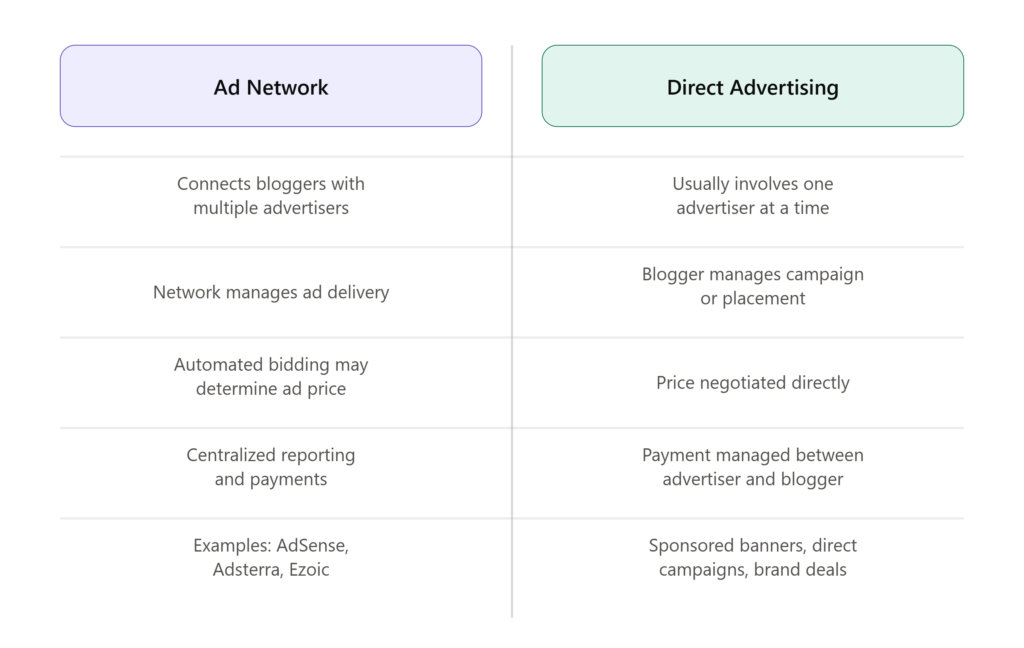
An ad network connects bloggers with multiple advertisers and handles much of the process involved in selling and delivering advertisements. The network can provide targeting, ad serving, reporting, payment processing, and optimization.
While, Direct advertising involves the blogger selling advertising space directly to a brand or advertiser.
For most bloggers, ad networks are easier to scale, while direct advertising can become more profitable once a website has a strong niche audience and enough traffic to attract advertisers independently.
Many established bloggers use both approaches rather than choosing only one.
How to Choose the Right Ad Network for Your Blog
Choosing the right ad network is not about picking the most popular platform it’s about selecting one that fits your traffic level, audience type, content quality, and monetization goals. The best network for a beginner blog will be very different from what a high-traffic publisher needs.
1. Start With Your Traffic Level
Your traffic determines which networks you can realistically join.
- 0–10K/month: Start with Google AdSense, Ezoic, or PropellerAds
- 10K–100K/month: Move to Monumetric or AdPushup
- 100K+/month: Consider Mediavine, Raptive, or Setupad
Don’t apply to premium networks too early approval will likely fail.
2. Match the Network to Your Audience
Different ad networks perform better for different audiences.
- Tier 1 traffic (US/UK/CA): Mediavine, Raptive
- Global / mixed traffic: Adsterra, Clickadu
- Gaming / community sites: NitroPay
- News / viral content: Taboola, Outbrain
Traffic GEO directly impacts your RPM and earnings.
3. Choose the Right Ad Formats
Not every format works for every blog.
- Display ads: Best for blogs (AdSense, Ezoic)
- Native ads: Taboola, Revcontent
- Push / Pop ads: PropellerAds, AdMaven
- Header bidding: Setupad, Publift
Focus on user experience + revenue balance, not just highest CPM.
4. Understand Revenue Potential (RPM)
Higher-tier networks usually pay more, but require better traffic.
- Low RPM: AdSense, Infolinks
- Medium RPM: Ezoic, Monumetric
- High RPM: Mediavine, Raptive, Publift
Better traffic quality = higher earnings (not just more traffic).
5. Check Approval & Requirements
Before applying, make sure your site meets key criteria:
- Original content
- Clean design and navigation
- Real human traffic
- Privacy policy + ads.txt
- No policy violations
Premium networks have strict manual reviews — prepare your site first.
6. Decide Between Self-Serve vs Managed
- Self-serve networks: Full control (Adsterra, PropellerAds)
- Managed platforms: Higher revenue but less control (Mediavine, Raptive)
Beginners should start with self-serve, then scale to managed solutions.
7. Test and Scale Strategically
Don’t rely on a single network from day one.
- Start with 1–2 networks
- Track RPM, CTR, and user engagement
- Remove low-performing setups
- Scale what works
Data-driven decisions always outperform assumptions.
Final Thoughts
The best ad network for bloggers in 2026 depends on the size of your website, the quality of your audience, your niche, and how visitors interact with your content. Google AdSense remains one of the strongest starting points because of its accessibility, advertiser demand, and international reach.
For bloggers looking for more advertising formats, Adsterra can be a strong alternative, while Ezoic is useful for publishers interested in automated optimization. More established blogs can consider Mediavine, Raptive, and SHE Media, depending on their traffic and content profile.
Smaller publishers should not assume that premium networks are automatically better. Journey by Mediavine, Monetag, Infolinks, and RevContent can provide alternative paths depending on the blog’s traffic and monetization strategy.
Bloggers should also avoid choosing a network solely because it advertises the highest CPM. RPM, revenue per session, revenue per visitor, ad quality, page speed, advertiser demand, and payment reliability are much more useful indicators of whether a network is actually improving the business.
For most bloggers, the strongest strategy is to start with a suitable network, collect enough performance data, test placements carefully, and move to a more advanced managed platform as traffic and content quality grow.
Frequently Asked Questions (FAQs)
Which Ad Network Is Best for Bloggers?
Google AdSense is one of the best overall choices for bloggers because it is widely available, relatively simple to implement, and supported by a large advertising ecosystem. However, Adsterra, Ezoic, Journey, Mediavine, and Raptive may be better depending on traffic volume, niche, audience geography, and monetization goals.
What Is the Best Ad Network for Small Blogs?
Google AdSense, Adsterra, Ezoic, Journey by Mediavine, Monetag, and RevContent can be considered by smaller blogs, although every platform has its own approval and quality requirements. Journey currently accepts sites with more than 1,000 sessions, while Ezoic states that its partner programs no longer use a universal pageview limit.
What Is the Best Ad Network for High-Traffic Blogs?
For high-traffic blogs, Mediavine and Raptive are among the strongest premium options to evaluate. Raptive currently accepts qualifying sites starting at 25,000 monthly pageviews, while Mediavine’s main offering uses an annual ad-revenue requirement rather than simply relying on a pageview threshold.
Which Ad Network Pays the Most?
There is no single ad network that always pays the most. Earnings depend on niche, audience location, device mix, seasonality, advertiser demand, viewability, ad placement, and user behavior. A network with a higher advertised CPM can produce less total revenue if it has lower fill rates or poorer engagement.
What Is the Best AdSense Alternative for Bloggers?
Adsterra, Ezoic, Media.net, Mediavine, Raptive, Monetag, and other platforms can serve as AdSense alternatives. The best option depends on your traffic and content. Adsterra is particularly useful for multiple formats, Ezoic emphasizes automated optimization, and premium platforms such as Raptive focus on established publishers.
Do Ad Networks Charge Bloggers to Join?
Many advertising networks do not charge publishers a traditional upfront membership fee, but terms differ between platforms. Some managed services may use revenue-sharing arrangements, contracts, or program-specific requirements. Bloggers should review the current publisher agreement before joining.
How Much Traffic Do I Need to Make Money With Ads?
There is no universal traffic requirement for making advertising revenue. Even a small blog can generate some revenue if it receives legitimate visitors, but meaningful advertising income generally requires consistent traffic. Premium networks often require substantially more traffic or revenue before accepting a publisher.
Can I Use Multiple Ad Networks on One Blog?
In some cases, yes, but bloggers must follow the policies of every platform they use. Certain networks, ad formats, or advertising partnerships can have restrictions regarding competing advertisements, placement, traffic sources, or ad density. Always check the current terms before combining networks.
Are Ad Networks Good for SEO?
Advertising itself does not automatically harm SEO, but excessive or intrusive advertising can create poor user experiences and performance problems. Bloggers should prioritize page speed, Core Web Vitals, readable content, mobile usability, and reasonable ad density instead of maximizing the number of advertisements on every page.
Should New Bloggers Use Ad Networks or Affiliate Marketing?
New bloggers can use both, but the best choice depends on the content. Display advertising works particularly well when a site has consistent traffic and many pageviews, while affiliate marketing can be more effective when readers have strong purchase intent. Product reviews, comparisons, buying guides, and commercial tutorials can often work well with affiliate monetization alongside advertising.