

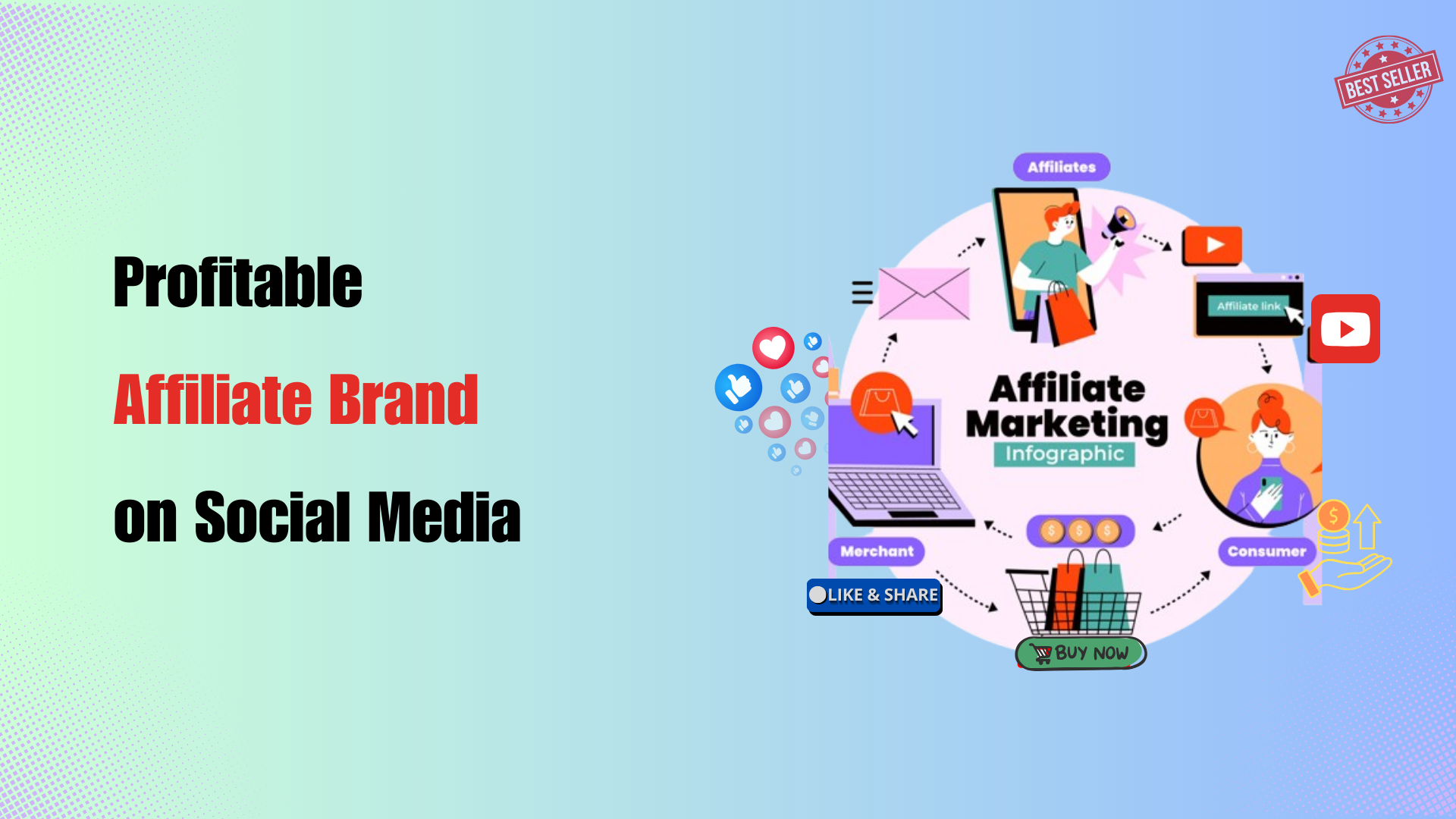
How to Build a Profitable Affiliate Brand on Social Media
Affiliate marketing on social media is easy to start but surprisingly difficult to turn into a real business.
You can join an affiliate program today, share a few links, and possibly make a sale. But that does not mean you have built an affiliate brand.
A profitable affiliate brand is different. People follow you for a specific reason, trust your recommendations, remember your content, and eventually come back when they need help choosing a product.
That trust is what makes social media affiliate marketing sustainable.
The basic model is simple:
Choose the Right Audience
        ↓
Build Clear Positioning
        ↓
Create Useful Content
        ↓
Earn Trust
        ↓
Recommend Relevant Products
        ↓
Generate Affiliate Sales
        ↓
Track What Works
        ↓
Scale the Winners
The affiliate link is only one small part of the system.
Start With a Niche People Actually Buy From
The best affiliate niche combines audience demand, your ability to create useful content, and enough relevant products to monetize over time.
This is where many affiliate marketers make their first mistake.
They choose a product because the commission looks attractive and then try to build an audience around it.
It should work the other way around.
First decide who you want to help.
Then understand what that audience regularly buys.
For example, instead of creating a broad “technology” page, you could build around:
- AI tools for freelancers
- software for small businesses
- creator equipment
- budget gaming setups
- WordPress tools
The more clearly people understand what your account is about, the easier it becomes to build authority.
At the same time, avoid going so narrow that you only have one product to promote.
A strong niche should give you an entire product ecosystem.
For example, a creator-focused brand could eventually promote cameras, microphones, editing tools, AI software, hosting, email platforms, design tools, and online courses.
That gives the business room to grow without confusing the audience.
A Simple Niche Test
Before committing to a niche, ask:
| Question | What You Want |
|---|---|
| Do people actively discuss this problem? | Yes |
| Are people already spending money here? | Yes |
| Are multiple affiliate programs available? | Yes |
| Can I create useful content consistently? | Yes |
| Can I add experience or real analysis? | Yes |
If most answers are yes, you probably have something worth building.
Build a Brand Before You Start Selling
Your social profile should immediately tell people who you help, what you talk about, and why your content is worth following.
You do not need an elaborate logo or expensive brand identity.
You need clarity.
Compare these two bios:
Generic:
Digital Marketer | Entrepreneur | Affiliate Marketer
Clear:
I test AI and marketing tools that help small businesses save time and grow faster.
The second one instantly creates context.
A visitor understands:
- who the content is for;
- what the account discusses;
- what type of recommendations to expect.
That is brand positioning.
Keep Your Content Around a Few Core Topics
If your account is about AI tools for marketers, your content pillars might be:
- AI tool reviews
- marketing automation
- productivity workflows
- software comparisons
Now your affiliate recommendations feel natural because they sit inside topics your audience already expects you to cover.
This is much stronger than randomly promoting whatever program happens to offer the highest commission that month.
Create Content People Would Value Even Without the Affiliate Link
The best affiliate content solves a problem first and sells second.
This is probably the most important rule in social media affiliate marketing.
If every post ends with:
“Buy this.”
people eventually stop paying attention.
Instead, build content around questions people already have.
For example, rather than posting:
“This is the best email marketing software. Use my link.”
Create:
“Three email marketing tools I tested for a small newsletter — and which one I would actually pay for.”
Now the affiliate recommendation is part of useful content rather than the entire reason the content exists.
Four Content Formats Work Especially Well
Tutorials
Show people how to accomplish something.
The product becomes part of the process.
For example:
How I automate social media reporting in 15 minutes.
You can naturally demonstrate the tool you use.
Comparisons
People searching for comparisons are often close to making a decision.
Examples:
- Canva vs Adobe Express
- Hostinger vs Bluehost
- ConvertKit vs Mailchimp
Do not simply declare a winner.
Explain who each product is best for.
That makes the recommendation much more credible.
Real Product Reviews
A useful review should answer more than “Is it good?”
Explain:
- what you liked;
- what frustrated you;
- who should use it;
- who probably should not;
- whether the price makes sense;
- what alternatives exist.
Balanced reviews usually build more trust than overly positive ones.
Problem-Based Content
Start with the pain point rather than the product.
For example:
Why your phone videos still look bad even with an expensive camera.
Then explain the problem and introduce relevant equipment naturally.
This style works because the audience receives value whether they buy anything or not.
Use Each Social Platform for What It Does Best
Different platforms influence different stages of the buying journey, so your affiliate strategy should not be identical everywhere.
You do not need to be active on every platform.
You do need to understand what each platform is good at.
| Platform | Best Use |
|---|---|
| Discovery, community and product demonstrations | |
| TikTok | Fast discovery and problem-driven videos |
| YouTube | Reviews, tutorials and product comparisons |
| Evergreen visual discovery | |
| B2B tools, SaaS and professional products | |
| X | Discussions, recommendations and thought leadership |
Instagram and TikTok
Use short-form content to create interest.
A good structure is:
Problem
   ↓
Interesting Insight
   ↓
Quick Solution
   ↓
Product Demonstration
   ↓
Call to Action
Start with the problem, not the affiliate offer.
YouTube
YouTube is particularly valuable for products that require research.
Someone watching a 12-minute comparison between two software platforms is usually much closer to purchasing than someone casually watching a 15-second Reel.
That makes YouTube especially strong for:
- software;
- electronics;
- tools;
- courses;
- expensive products.
Pinterest can work well when users are already looking for ideas, products, inspiration, or planning information.
Unlike fast-moving social feeds, useful Pinterest content can continue generating discovery traffic long after publication.
Do Not Send Every Visitor Straight to an Affiliate Link
The stronger your affiliate business becomes, the more important it is to build a proper path between social content and the final purchase.
Sometimes a direct affiliate link makes sense.
If someone just watched your complete product review, they may already be ready to buy.
But other users need more information first.
A simple funnel might look like this:
Social Post
    ↓
Profile
    ↓
Helpful Resource
    ↓
Product Comparison
    ↓
Affiliate Link
    ↓
Purchase
For higher-priced products, you could also use email:
Social Content
    ↓
Free Guide
    ↓
Email Signup
    ↓
Useful Follow-Up
    ↓
Product Recommendation
This has another major advantage.
You begin building an audience you control.
Social media platforms can change algorithms, reach, features, or policies. An email list or website gives your affiliate business some independence from those changes.
Choose Products Based on More Than Commission
A high commission percentage does not automatically make an affiliate program profitable.
Consider this:
| Product | Commission | Product Price | Potential Earnings |
|---|---|---|---|
| Product A | 40% | $25 | $10 |
| Product B | 20% | $200 | $40 |
| Product C | 10% | $700 | $70 |
Product A offers the highest percentage.
Product C produces the highest commission per sale.
But even this comparison is incomplete.
You should also consider:
- how well the product fits your audience;
- merchant conversion rate;
- average order value;
- recurring commission;
- refund rate;
- attribution window;
- commission reversals;
- merchant reputation.
A lower-paying program that converts consistently can outperform a flashy high-commission offer.
More importantly, never sacrifice audience trust for a better payout.
One poor recommendation can cost more than the commission it generates.
Track Revenue, Not Just Followers and Views
The goal of an affiliate business is not maximum engagement. It is profitable, qualified attention.
A viral video can generate hundreds of thousands of views and almost no revenue.
A small comparison video can generate far fewer views and dozens of purchases.
That is why affiliate marketers should look beyond vanity metrics.
Track:
Affiliate Clicks
Are people interested enough to investigate the product?
Conversion Rate
How many affiliate visitors actually purchase?
Earnings Per Click
EPC helps you understand how efficiently your traffic produces revenue.
Approved Revenue
Do not only look at pending commissions.
Refunds, cancellations, rejected leads, and reversals can significantly change the final amount.
Build Trust Through Honest Recommendations
Trust is the real asset behind every successful affiliate brand.
Do not make every product sound perfect.
Say when something is:
- expensive;
- difficult to use;
- unnecessary for beginners;
- missing an important feature;
- better suited to another audience.
For example:
“This is the better tool for agencies, but I would not recommend paying for it if you only manage one website.”
That is far more useful than:
“Amazing tool! Highly recommended!”
Experienced audiences recognize exaggerated affiliate content immediately.
The creators who become valuable are usually the ones willing to say:
This product is good — but it is not right for everyone.
Make Affiliate Disclosures Clear
People should know when you may earn money from a recommendation.
Do not hide the relationship.
A simple disclosure is enough:
“This post contains affiliate links. I may earn a commission if you purchase through them.”
Clear disclosure supports transparency and helps protect the credibility of your recommendations.
Also check the disclosure and branded-content requirements of the social platform and affiliate program you are using.
Common Mistakes
Promoting Too Many Unrelated Products
If followers cannot understand what your brand stands for, authority becomes difficult to build.
Choosing Offers Only by Commission
Commission percentage means very little without conversion.
Posting Product Links Without Context
Give people a reason to care before asking them to click.
Copying Merchant Marketing Material
Your audience can already read the merchant’s website.
Add your own experience, comparison, analysis, or use case.
Caring More About Followers Than Buyers
A smaller, highly relevant audience can be far more valuable than a huge general audience.
Depending on One Platform
Use social platforms for discovery, but gradually build assets such as a website or email list.
A Better Social Affiliate Workflow
Instead of:
Find High Commission
       ↓
Post Product
       ↓
Drop Link
       ↓
Hope for Sales
Build this:
Understand Audience
       ↓
Identify Problems
       ↓
Choose Relevant Products
       ↓
Create Useful Content
       ↓
Build Trust
       ↓
Show Proof
       ↓
Recommend Naturally
       ↓
Track Conversions
       ↓
Improve What Works
That is the difference between running an affiliate account and building an affiliate brand.
Final Thoughts
The most profitable affiliate brands on social media are not the accounts sharing the most links.
They are the accounts people trust when they are about to make a buying decision.
Build around a clear audience. Solve real problems. Recommend products that genuinely fit those problems. Explain the good and the bad. Track what actually produces revenue.
Then let affiliate links do what they are supposed to do: monetize the trust you have already earned.
That is a much stronger business than constantly chasing the next high-commission offer.
Frequently Asked Questions (FAQs)
Can you make money with affiliate marketing on social media?
Yes, but profitability depends on audience relevance, product fit, trust, conversion rate, and affiliate program economics rather than follower count alone.
Do you need a large following?
No. A smaller niche audience with strong purchase intent can outperform a much larger general audience.
Which social platform is best for affiliate marketing?
There is no single best platform. YouTube works particularly well for reviews and comparisons, while Instagram and TikTok are strong for discovery and demonstrations. Pinterest can support evergreen discovery, and LinkedIn can work well for B2B affiliate products.
Should you promote several affiliate products?
Yes, provided they solve related problems for the same audience. Promoting too many unrelated products can weaken your brand positioning.
Can you build an affiliate brand without showing your face?
Yes. Tutorials, product demonstrations, screen recordings, voiceovers, comparison videos, and niche educational content can all work without a personality-led format.