

Accountant Facebook Ads can help accounting firms generate new client enquiries when the campaign is built around a specific audience, service, offer, location, and follow-up process. Instead of simply advertising “accounting services,” create an offer such as a consultation, tax review, bookkeeping assessment, or business-owner checklist, then use Meta Ads to reach relevant prospects and retarget people who already interacted with your business.
The most important part is not getting the cheapest lead. It is generating qualified leads that become consultations and paying clients. A successful campaign therefore connects the ad, landing page or lead form, qualification process, CRM, follow-up, consultation, and final client acquisition into one measurable funnel.
Unlike Google Search, where someone may already be searching for “accountant near me,” Meta advertising can introduce an accounting firm to people before they actively search for an accountant. This means the advertisement has to create the reason to take action.
This guide explains how to build the system from the ground up.
What Are Accountant Facebook Ads?
Accountant Facebook Ads are paid advertisements on Facebook and related Meta placements that accounting professionals use to generate awareness, enquiries, consultations, leads, or new clients.
Depending on the campaign, an accounting firm might advertise:
- Personal tax preparation
- Business tax services
- Bookkeeping
- Payroll services
- Corporate accounting
- Tax planning
- Business formation support
- Management accounting
- VAT or sales-tax services
- Financial reporting
- CFO or advisory services
- Accounting software support
- Year-end accounts
- Specialist industry accounting
The important distinction is that the advertisement is not the entire marketing system.
A simple funnel looks like this:
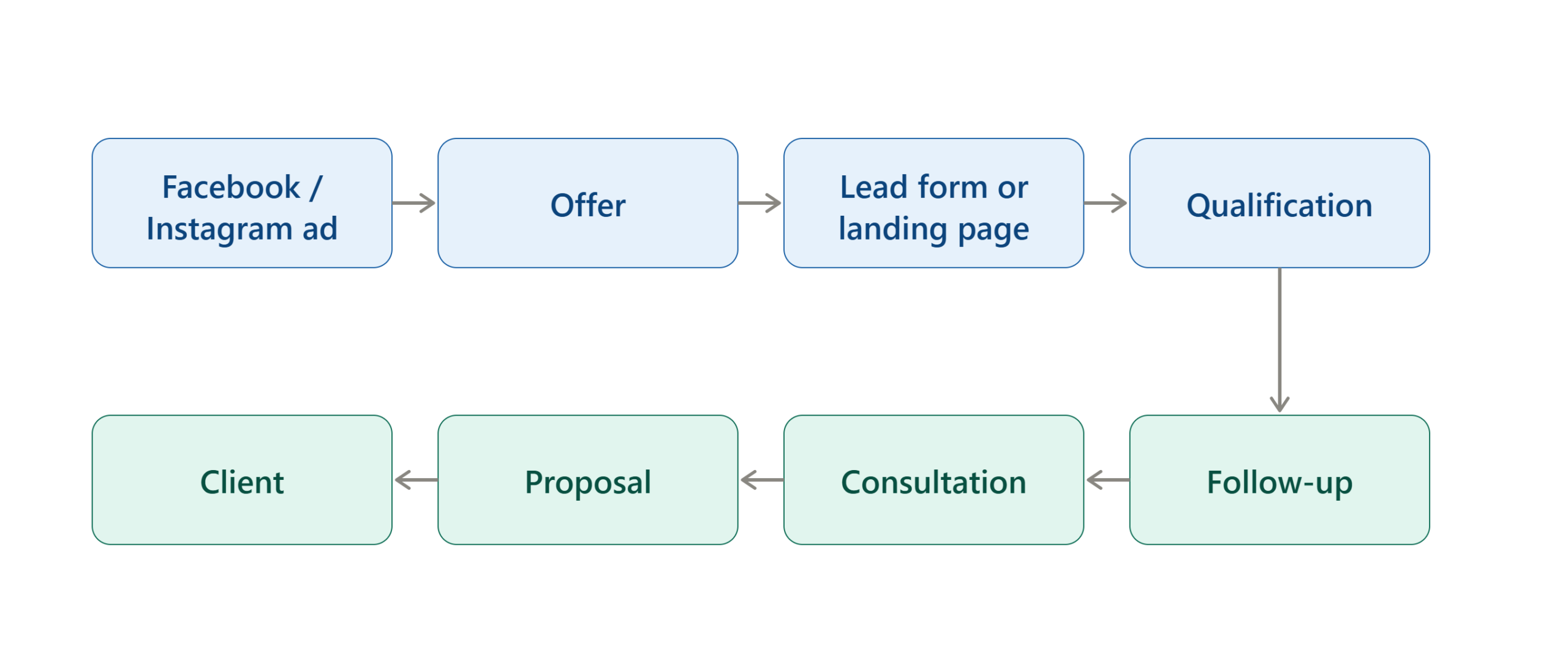
If the campaign produces hundreds of leads but nobody follows them up quickly, the advertising has not solved the business problem.
Can Facebook Ads Actually Get More Accounting Clients?
Yes, but Facebook Ads should not be treated as a guaranteed client-generation machine.
Meta advertising can be particularly useful when an accounting firm has:
- A clearly defined target market
- A specific service to promote
- A compelling offer
- A credible website or landing page
- A reliable follow-up process
- Sufficient conversion data
- A realistic advertising budget
- A service with enough customer lifetime value to support acquisition costs
Recent accounting-focused campaigns demonstrate that results can vary substantially depending on the offer, targeting, qualification, geography, follow-up and measurement. For example, published case studies report substantial lead volumes, but those figures are agency-reported results and should not be treated as universal benchmarks.
The practical lesson is simple:
Do not copy another accounting firm’s CPL and assume you will achieve the same result. Build your economics around your own client value and conversion rates.
Why Are Accountant Facebook Ads Important?
Facebook Ads can give accounting firms another acquisition channel instead of depending entirely on referrals, organic search, directories, or existing networks.
Reach Potential Clients Before They Search
A business owner may not search for a new accountant today, but they may still recognize a problem: Bookkeeping is taking too long, Their current accountant is slow, Their tax bill is higher than expected.
An effective advertisement turns that problem into a reason to engage.
Build Familiarity Before the Consultation
Accounting is highly trust-sensitive.
Someone who has watched several useful videos from an accounting firm may be more comfortable booking a consultation than someone seeing the company for the first time.
Generate Demand for Specialized Services
Instead of promoting every service at once, firms can create campaigns around specific problems.
For example:
Generic:
Need an accountant? Contact us today.
More specific:
Just started a limited company? Get a free 15-minute accounting setup consultation.
The second message gives the audience a reason to act.
Support Seasonal Client Acquisition
Accounting demand often changes throughout the year.
Tax deadlines, year-end reporting, business formation periods, payroll requirements, and other financial events can create temporary increases in demand.
A recent accounting-marketing guide specifically recommends aligning campaigns with tax-season and other deadline-driven opportunities rather than treating every month identically.
How Do Accountant Facebook Ads Work for Accounting Firms?
A typical campaign has six stages:
| Stage | What Happens | Main Goal |
|---|---|---|
| 1. Audience | Meta identifies potential prospects | Reach |
| 2. Creative | User sees the advertisement | Attention |
| 3. Offer | Ad explains a relevant benefit | Interest |
| 4. Conversion | User submits a form or visits a page | Lead |
| 5. Qualification | Firm evaluates the prospect | Lead quality |
| 6. Follow-up | Firm contacts and consults prospect | Client |
The campaign should therefore be optimized around the business outcome, not just clicks.
For example:
1,000 impressions → 30 leads → 10 consultations → 3 clients
may be much better for an accounting firm than:
1,000 impressions → 80 leads → 2 consultations → 0 clients.
The second campaign has a lower apparent lead cost but a worse commercial outcome.
What Should You Prepare Before Running Facebook Ads?
Before opening Meta Ads Manager, prepare the business side of the campaign.
Define Your Ideal Accounting Client
Do not start with:
Everyone who needs an accountant.
Instead define characteristics such as:
- Location
- Business type
- Company size
- Industry
- Approximate stage of business
- Service required
- Common problem
- Buying motivation
- Likely objections
- Approximate client value
For example:
Target: Local service-business owners with 1–20 employees who need ongoing bookkeeping and tax support.
That is much more actionable than:
Target: Small businesses.
Choose One Primary Service
Avoid advertising ten services in one campaign.
Start with one commercially valuable service.
For example:
Campaign A: Small-business bookkeeping
Campaign B: Business tax consultation
Campaign C: New-company accounting setup
This makes it easier to match the audience, message and offer.
Create a Strong Offer
The offer is often more important than the headline.
Possible offers include:
- Free initial consultation
- Free bookkeeping review
- Tax planning consultation
- Business accounting health check
- New-business accounting checklist
- Free payroll assessment
- Fixed-fee accounting consultation
- Tax deadline preparation session
The offer should provide enough value to justify exchanging contact information.
How to Choose the Best Facebook Ad Offer for an Accounting Firm
A strong offer should satisfy three conditions:
Relevant → Valuable → Easy to Understand
Example 1: Tax Services
Weak:
Professional tax services available.
Better:
Worried about your upcoming tax return? Book a consultation with a local tax professional.
Example 2: Bookkeeping
Weak:
We provide bookkeeping services.
Better:
Spending too much time managing your books? See how much time your business could save with managed bookkeeping.
Example 3: New Businesses
Weak:
Accounting for startups.
Better:
Just launched your business? Get a practical accounting setup checklist and learn what to organize from day one.
The offer should match the stage of the customer.
How to Define Your Facebook Ads Target Audience
Audience strategy should begin with the customer, not the Ads Manager targeting options.
Local Accounting Firms
If your firm serves a specific city or region, start with geographic relevance.
For example:
- City
- Nearby towns
- Service radius
- Specific business locations
Use local language where appropriate.
Instead of:
Professional accounting services.
Try:
Looking for a business accountant in Manchester?
A location-specific message can immediately tell the user that the service is relevant.
Small-Business Accounting
Potential audiences may include:
- Business owners
- Entrepreneurs
- Self-employed professionals
- Freelancers
- Contractors
- Local business operators
- Startup founders
However, targeting options change over time, and Meta’s delivery systems increasingly use automated audience and placement capabilities. Do not assume that an old targeting tutorial accurately reflects today’s Ads Manager interface.
Specialist Accounting Niches
A specialist offer can be easier to position than a general accounting service.
Examples include:
- Construction accounting
- Medical-practice accounting
- Ecommerce accounting
- Real-estate accounting
- Restaurant accounting
- Contractor accounting
- Startup accounting
- Professional-services accounting
The narrower the service, the more specific the advertisement can become.
How to Create Facebook Ads for Accounting Firms
This is the core process.
Step 1 — Choose the Campaign Goal
Start with the business result you want.
For client acquisition, common outcomes include:
- Lead generation
- Website enquiries
- Consultation bookings
- Calls
- Messages
If you need contact details and qualification information, a lead-generation workflow is often a practical starting point.
Do not select an objective simply because it produces a large number of cheap actions.
The campaign should support the actual sales process.
Step 2 — Choose Your Conversion Path
You generally have two useful paths.
Option A: Meta lead form
Ad → Instant Form → CRM/Firm Follow-Up
This reduces the number of steps between seeing the ad and becoming a lead.
Option B: Website landing page
Ad → Landing Page → Booking/Form → CRM
This gives you more control over the information and sales experience.
Use the landing-page route when prospects need more explanation before contacting the firm.
Step 3 — Build the Lead Form or Landing Page
Your form should collect enough information to qualify the lead without creating unnecessary friction.
Useful fields may include:
- Name
- Phone
- Business type
- Service required
- Approximate business size
- Location
- Preferred consultation time
For example:
What service do you need?
- Business tax
- Bookkeeping
- Payroll
- Tax planning
- Other
This information can help the firm prioritize and route enquiries.
Meta’s customer-list audience terms also make clear that advertisers are responsible for having the necessary rights, permissions and lawful basis when using customer data for audience creation.
That makes privacy and data governance particularly important for professional-service firms.
Step 4 — Write the Ad Copy
A practical accounting ad can use this structure:
Problem → Audience → Solution → Offer → CTA
For example:
Running a growing small business but spending too much time on your books?
Our accounting team helps local business owners manage bookkeeping, tax and reporting without the administrative headache.
Book an introductory consultation to discuss your accounting needs.
Book Your Consultation
The advertisement should not make unrealistic financial promises.
Step 5 — Create the Visual
Accounting ads do not have to look like traditional corporate advertisements.
Useful creative concepts include:
- Accountant speaking directly to camera
- Short educational videos
- Simple tax tips
- Before/after workflow illustrations
- Client problem scenarios
- Office/team photographs
- Service-specific graphics
- Short FAQ videos
Meta’s current Reels guidance emphasizes mobile-first creative and recommends incorporating Reels into campaign placements, while also supporting testing and creative optimization.
For video, show the main message early rather than making the viewer wait through a long introduction.
Step 6 — Add a Clear Call to Action
Your CTA should match the desired action.
Examples:
- Book a Consultation
- Get a Free Consultation
- Request a Quote
- Get Your Checklist
- Speak With an Accountant
- Learn More
- Get Started
Avoid vague CTAs when the next action is obvious.
Step 7 — Launch a Controlled Test
Do not immediately spend a large budget across dozens of audiences and advertisements.
Begin with a controlled test.
Test variables such as:
- Offer
- Hook
- Creative
- Audience
- Landing page
- Lead form
- CTA
The goal is to discover which combination produces qualified opportunities, not simply which advertisement generates the most clicks.
Step 8 — Connect Leads to Your Follow-Up System
This is one of the most important steps.
A lead should not sit in an inbox for several days.
Ideally:
New Lead → Instant Notification → Qualification → Personal Follow-Up → Consultation → Proposal
A CRM can help organize this process.
Track:
- New lead
- Contacted
- Qualified
- Consultation booked
- Consultation completed
- Proposal sent
- Won
- Lost
Without this information, you cannot determine which advertising campaigns actually create revenue.
Step 9 — Retarget Warm Prospects
Not everyone will become a client after one advertisement.
Retarget relevant audiences such as people who:
- Visited your website
- Watched your videos
- Engaged with your Facebook Page
- Engaged with Instagram content
- Opened a lead form
- Previously interacted with your advertising
Customer-list audiences can also be used where the relevant legal permissions and Meta requirements are satisfied. Meta states that advertisers must have the necessary rights and lawful basis to use uploaded customer data for audience creation.
A retargeting message can be different from the initial advertisement.
Cold audience:
Need help managing your business accounts?
Warm audience:
Still looking for an accountant? Book a consultation with our team and discuss your current accounting setup.
How Much Should an Accounting Firm Spend on Facebook Ads?
There is no universal “correct” Facebook Ads budget for accountants.
Published industry guides sometimes provide budget or CPL ranges, but these are not reliable universal benchmarks because location, service, competition, offer, audience and lead quality can change campaign economics significantly.
A better approach is to calculate the budget from your economics.
Suppose:
- Average first-year client value = $3,000
- Gross profit contribution = $1,800
- Acceptable acquisition cost = $600
- Lead-to-client rate = 5%
Then the maximum economically sensible lead cost would be approximately:
$600 × 5% = $30 per lead
This is only an illustrative calculation. Your actual numbers should come from your firm’s margins and conversion data.
Track These Metrics
Do not stop at:
CPL = Advertising Spend ÷ Leads
Also measure:
- Cost per Qualified Lead
- Cost per Consultation
- Cost per Acquired Client
- Client Acquisition Cost = Total Acquisition Spend ÷ New Clients
And, where possible:
Revenue from Ads ÷ Advertising Cost
The deeper metric is what happens after the lead.
Which Accounting Services Work Best With Facebook Ads?
Not every accounting service has the same advertising potential.
| Service | Potential Facebook Offer | Best Funnel |
|---|---|---|
| Tax preparation | Tax consultation | Lead form |
| Bookkeeping | Free bookkeeping review | Lead form |
| Business accounting | Consultation | Landing page |
| Payroll | Payroll assessment | Lead form |
| Startup accounting | Setup checklist | Lead magnet |
| Tax planning | Planning consultation | Landing page |
| CFO advisory | Strategy consultation | High-trust landing page |
| Specialist accounting | Niche-specific consultation | Landing page |
Higher-value services can justify a more detailed funnel because the potential client value is greater.
How to Write High-Converting Facebook Ads for Accountants
A good accounting advertisement should answer four questions quickly:
- Who is this for?
- What problem does it solve?
- Why should I care?
- What should I do next?
Ad Formula 1 — Problem-Based
Still spending hours keeping your business accounts up to date?
Our bookkeeping team helps small businesses reduce the administrative workload and keep financial records organized.
Book an introductory consultation.
Ad Formula 2 — Seasonal
Tax deadline approaching?
Get professional support preparing your business tax return and identifying the information you need before filing.
Speak with our accounting team.
Ad Formula 3 — Business Growth
Your business is growing. Is your accounting system keeping up?
We help growing businesses with bookkeeping, tax, reporting and ongoing accounting support.
Book a consultation.
Ad Formula 4 — Educational
Three bookkeeping mistakes can create unnecessary problems for a growing business.
Download our practical bookkeeping checklist and see what to review before your next reporting period.
Educational offers can be useful when the audience is not yet ready to hire an accountant.
What Makes Accounting Facebook Ads Different From Other Ads?
Accounting is a high-trust professional service. That means the advertisement should avoid excessive hype.
Use Proof Carefully
Useful trust elements include:
- Professional qualifications
- Years in business, if accurate
- Relevant certifications
- Genuine testimonials
- Real client reviews
- Industry specialization
- Local presence
- Clear service descriptions
- Transparent consultation process
Do not invent testimonials, results, savings or client numbers.
Explain Rather Than Promise
Weak:
We will save you thousands in taxes!
Better:
Speak with our tax team to identify potential planning opportunities relevant to your situation.
The second version is more credible and avoids making an outcome guarantee.
How to Use Facebook and Instagram Together
Facebook and Instagram are both part of Meta’s advertising ecosystem, so a campaign does not necessarily need to be treated as two completely separate marketing systems.
Meta supports placements across Facebook, Instagram and other surfaces, with Advantage+ placements designed to allow delivery across eligible placements.
A practical approach is to create creative that works across placements while adapting the format when necessary.
For Instagram Reels
Prioritize:
- Vertical video
- Strong opening
- Captions
- Clear visual hierarchy
- Short explanations
- Human presentation
For Facebook Feed
Prioritize:
- Clear headline
- Strong image or video
- Specific offer
- Local or audience relevance
- Easy-to-understand CTA
The message can remain consistent while the creative presentation changes.
How to Use Retargeting for Accounting Clients
Retargeting is particularly useful because accounting decisions often require consideration.
A potential client may:
- See your advertisement.
- Visit your website.
- Read about your services.
- Leave.
- Compare other accountants.
- Return later.
- Book a consultation.
A retargeting campaign can keep the firm visible during that process.
Retargeting Sequence
- First interaction: Educational content.
- Second interaction: Specific service explanation.
- Third interaction: Consultation or offer.
This is often more natural than showing the same “Book Now” advertisement repeatedly.
How to Measure Whether Your Accountant Facebook Ads Are Working
Use a complete funnel rather than one metric.
| Metric | What It Tells You |
|---|---|
| Reach | How many people saw the ads |
| Impressions | How often ads were shown |
| CTR | Whether the creative generates interest |
| Leads | Number of enquiries |
| CPL | Cost to generate a lead |
| Qualified leads | Lead relevance |
| Consultations | Sales opportunity |
| Show rate | Lead commitment |
| Clients | Actual acquisition |
| CAC | Cost per new client |
| Revenue | Commercial result |
Example Funnel
Imagine a campaign produces:
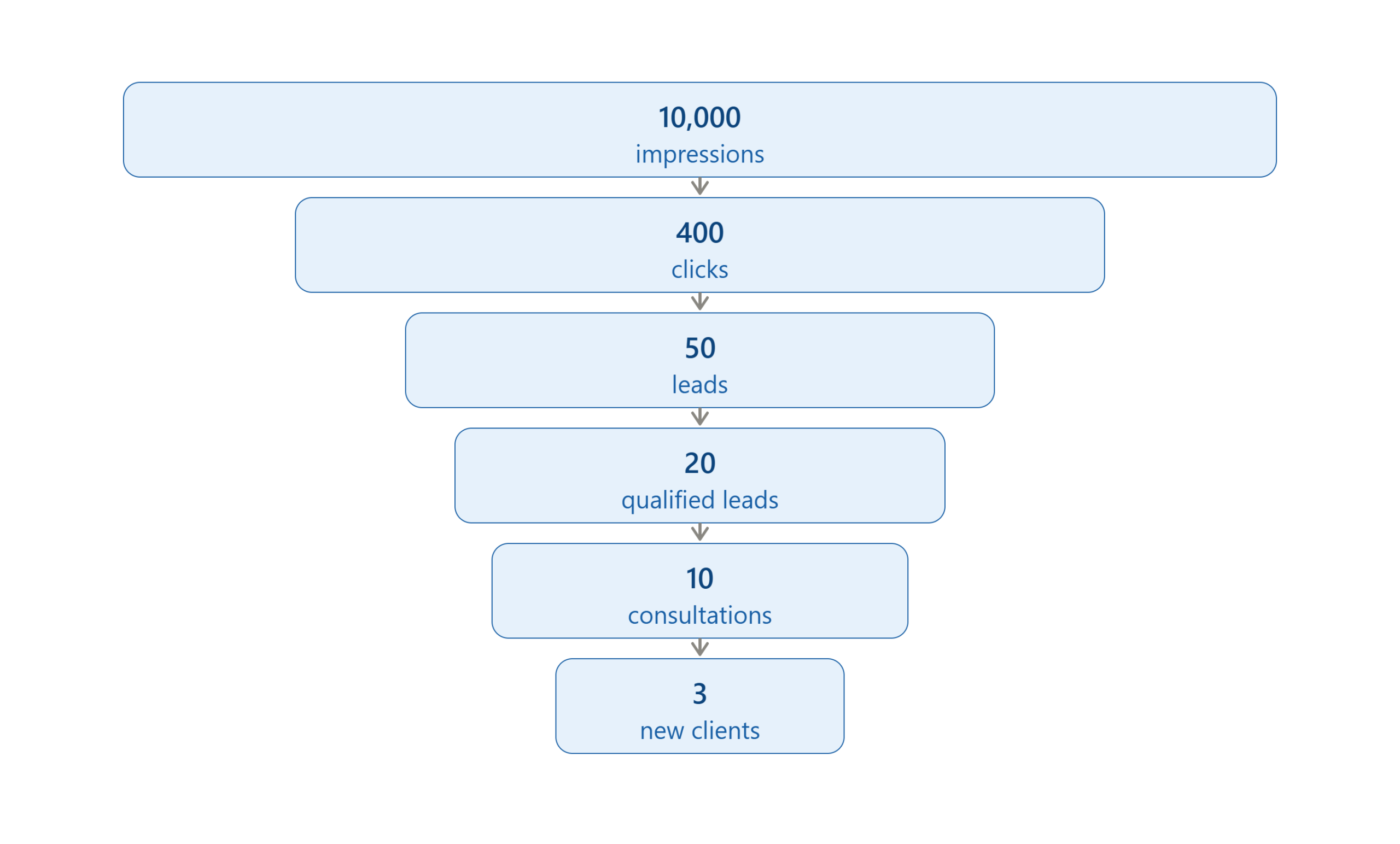
The business should optimize the weakest stage. If there are many clicks but few leads, improve the landing page or offer.
If there are many leads but few qualified prospects, improve targeting and qualification. If there are many consultations but few clients, investigate sales, pricing, positioning, or service fit.
How to Troubleshoot Accountant Facebook Ads
| Problem | Possible Cause | Solution |
|---|---|---|
| Lots of clicks, few leads | Weak landing page | Improve offer and conversion path |
| Cheap leads but poor quality | Broad audience or weak qualification | Add relevant questions and improve targeting |
| Leads do not answer | Slow follow-up | Contact leads quickly and use multiple follow-up methods |
| High CPL | Weak creative or competitive market | Test new hooks, offers and audiences |
| Good leads but few clients | Sales problem | Improve consultation and proposal process |
| Ad fatigue | Same creative shown repeatedly | Introduce new creative |
| Good traffic, low conversion | Offer mismatch | Align landing page with advertisement |
| Strong results initially, then decline | Audience saturation or creative fatigue | Refresh creative and test new audiences |
| Campaign spends but produces little | Poor offer, tracking or setup | Check campaign configuration and conversion path |
| Results vary by location | Different market economics | Analyze locations separately |
Problem: You Get Leads but They Are Not Good
Do not immediately conclude that Facebook is ineffective.
First examine:
- What advertisement produced the lead?
- What promise did the advertisement make?
- What information did the lead provide?
- Was the audience too broad?
- Did the form ask enough qualifying questions?
- Was the offer attracting people who only wanted free information?
The solution may be better qualification rather than more targeting.
Common Mistakes With Accountant Facebook Ads
Mistake 1 — Advertising Every Service at Once
A generic advertisement is difficult to personalize. Create campaigns around specific client problems.
Mistake 2 — Optimizing Only for Cheap Leads
A $10 lead is not automatically better than a $40 lead. If the $40 leads become clients and the $10 leads do not, the cheaper campaign is commercially worse.
Mistake 3 — Using a Generic “Contact Us” Offer
A cold prospect needs a reason to provide their information. Offer something useful and relevant.
Mistake 4 — Sending Traffic to a Weak Homepage
A homepage may contain too many choices. A dedicated landing page can focus the visitor on one service and one conversion goal.
Mistake 5 — Ignoring Follow-Up
A lead is not a client. The firm needs a process for contacting, qualifying and converting prospects.
Mistake 6 — Copying Another Firm’s Targeting
A successful campaign in London may not perform the same way in New York, Dubai or Toronto. Market conditions differ.
Mistake 7 — Making Unsupported Financial Promises
Avoid guaranteed tax savings, guaranteed returns or unrealistic financial outcomes. Accounting advertising should prioritize credibility.
What Should Accountants Test in Facebook Ads?
Testing should be systematic.
Test the Offer
A: Free consultation
B: Free accounting review
C: Downloadable checklist
Test the Hook
A: Save time
B: Reduce accounting stress
C: Prepare for tax season
D: Improve business financial visibility
Test the Creative
A: Accountant video
B: Professional image
C: Educational graphic
D: Client-problem scenario
Test the Funnel
A: Instant lead form
B: Website landing page
C: Consultation booking page
Do not change everything simultaneously.
If you change the audience, offer, creative and landing page at once, it becomes difficult to determine what caused the result.
Expert Insights for Accounting Facebook Ads
The biggest strategic mistake is thinking of Facebook Ads as a lead-generation activity instead of a client-acquisition system.
A more useful model is:
Ad → Lead → Qualified Lead → Consultation → Proposal → Client → Retained Client
The advertising campaign should ultimately be judged by what happens at the end of this chain.
Expert Insight: Build Around Client Value
If an accounting client stays for several years, the value of that relationship may be much higher than the first invoice.
That does not mean an accounting firm should spend without limits. It means acquisition decisions should consider:
- First-year revenue
- Gross margin
- Retention
- Upsells
- Cross-sells
- Referral value
- Service capacity
Expert Insight: Seasonal Campaigns Should Change the Message
Do not simply increase the budget during tax season. Change the reason to act.
Before a deadline:
Get prepared before your filing deadline.
After tax season:
Review your accounting setup for the next financial year.
For growing businesses:
Get your bookkeeping under control before growth creates more administrative work.
Expert Insight: Lead Quality Is a Design Problem
If a campaign attracts the wrong audience, the problem may not be the audience settings alone.
The offer itself filters people.
Compare:
Free accounting consultation
with:
Free 20-minute bookkeeping review for established small businesses.
The second offer communicates who it is for and naturally discourages some irrelevant enquiries.
A Simple Accountant Facebook Ads Decision Framework
Use this framework before launching.
Do you have a clearly defined service?
Yes → Continue.
No → Choose one service before advertising.
Do you have a specific audience?
Yes → Continue.
No → Define your ideal client.
Do you have a compelling offer?
Yes → Continue.
No → Create a consultation, review, checklist or another relevant offer.
Can you respond to leads quickly?
Yes → Launch a controlled test.
No → Fix your follow-up process first.
Can you measure qualified leads and clients?
Yes → Optimize based on business outcomes.
No → Improve tracking before scaling.
How to Verify Your Facebook Ad Campaign Is Working
Successful completion should not mean:
“The advertisement was approved.”
It should mean that the campaign produces measurable business opportunities.
Check the following:
Campaign Level
- Ads are delivering.
- Correct locations are being reached.
- Spend is within budget.
- Creative is displaying correctly.
Lead Level
- Forms are working.
- Leads contain usable contact information.
- Qualification questions are producing useful data.
- Leads are reaching the correct staff member.
Sales Level
- Leads are being contacted.
- Consultations are being booked.
- Prospects attend consultations.
- Proposals are being sent.
- New clients are being recorded.
Revenue Level
- Advertising spend is recorded.
- Client acquisition cost is calculated.
- Revenue from acquired clients is tracked.
- Campaign performance is compared with other acquisition channels.
That is the difference between running Facebook Ads and building an accountable acquisition system.
Alternative Methods for Getting Accounting Clients
Facebook Ads should not necessarily operate alone.
Google Search Ads
Useful when prospects already search for: Accountant near me, Business accountant, Tax accountant, Bookkeeper near me, CPA for small business.
This captures existing demand.
SEO
SEO can build long-term organic visibility around accounting questions and commercial searches.
Referral Marketing
Existing clients can become a strong source of new business when the firm has a structured referral process.
LinkedIn may be particularly useful for B2B accounting services and professional audiences.
Email Marketing
Existing leads and prospects can be nurtured through educational content and service-specific campaigns.
The strongest acquisition strategy may combine channels rather than relying on one platform.
Accountant Facebook Ads Checklist
Before Launching
- Define the ideal client.
- Choose one primary service.
- Select a clear geographic market.
- Create a compelling offer.
- Prepare landing page or lead form.
- Write specific ad copy.
- Create multiple creative variations.
- Set an appropriate budget.
- Establish lead follow-up.
- Check privacy and data requirements.
- Set up conversion measurement.
During the Campaign
- Monitor spend.
- Check lead quality.
- Track qualified leads.
- Monitor consultation bookings.
- Test creative.
- Review audience performance.
- Watch for creative fatigue.
- Avoid making decisions from very small data samples.
After the Campaign
- Calculate cost per qualified lead.
- Calculate cost per consultation.
- Calculate customer acquisition cost.
- Identify winning offers.
- Identify poor-quality sources.
- Improve follow-up.
- Retarget warm prospects.
- Scale only after economics are validated.
Frequently Asked Questions
Are Facebook Ads good for accountants?
Facebook Ads can be useful for accountants when the firm has a defined audience, relevant offer, appropriate budget and strong follow-up system. They are generally more effective when the campaign promotes a specific client problem or service instead of simply advertising “accounting services.”
How do accountants get clients from Facebook?
Accountants can use Facebook and Instagram advertisements to promote consultations, tax services, bookkeeping, business accounting, educational resources and other offers. Prospects can submit a lead form or visit a landing page, after which the firm qualifies and follows up with them.
What should an accountant advertise on Facebook?
The best service depends on the firm’s market, but potential offers include tax preparation, bookkeeping, business accounting, payroll, tax planning, startup accounting and specialist industry services.
How much should an accountant spend on Facebook Ads?
There is no universal budget. Start with an amount the firm can afford to test and calculate acceptable acquisition costs based on client value, margins and conversion rates rather than copying another company’s advertised budget or CPL.
Should accountants use Facebook Lead Ads or a landing page?
Both can work. Lead forms can reduce friction, while landing pages provide more space to explain a high-value or complex service. Test the option that produces better qualified consultations rather than simply more submissions.
How can accountants improve Facebook lead quality?
Use a specific offer, narrow the message around a defined client type, include qualification questions, and track which leads actually become consultations and clients.
Should accounting firms advertise during tax season?
Tax season can create strong demand, but competition and costs may also change. The campaign should be planned around relevant deadlines and the firm’s capacity to handle new clients rather than automatically increasing spending.
Can Facebook Ads work for local accountants?
Yes. Local accounting firms can build campaigns around their service area and local customer problems. Location-specific copy and dedicated landing pages can make the offer more relevant.
Are Facebook Ads better than Google Ads for accountants?
Neither is universally better. Google can capture people actively searching for accounting services, while Meta can create demand and reach potential clients before they search. Many firms can benefit from testing both.
How long should accountants run Facebook Ads?
There is no fixed number of days that guarantees success. The campaign should run long enough to collect meaningful conversion information while being monitored against budget, lead quality and business outcomes.
Key Takeaways / Final Takeaway
Accountant Facebook Ads work best when they are designed around a specific client problem rather than a generic accounting-company advertisement.
The winning structure is:
Specific Audience → Specific Problem → Relevant Offer → Strong Creative → Simple Conversion Path → Fast Follow-Up → Qualified Consultation → Client
Start with one service and one audience. Build a useful offer, test multiple creative concepts, qualify leads, and track what happens after the form submission.
Most importantly, do not optimize your campaign solely for the lowest cost per lead. An accounting firm ultimately needs profitable clients, not a large database of irrelevant enquiries.
Published accounting advertising case studies show that Meta campaigns can produce substantial lead volumes, but reported results vary widely and should be treated as examples rather than guaranteed benchmarks.