

Facebook ads can generate leads for pest control companies when campaigns combine tight geographic targeting, pest-specific creative, a clear offer, low-friction lead capture, fast follow-up, and reliable conversion tracking. For most operators, the strongest campaigns focus on a specific problem—such as termites, rodents, ants, mosquitoes, cockroaches, or seasonal prevention—instead of advertising generic “pest control services.”
Meta should generally be treated as a demand-creation and retargeting channel, while high-intent platforms such as Google Search and Local Services Ads can capture people already searching for an exterminator. The right advertising mix depends on local demand, service type, margins, seasonality, competition, and actual cost per booked customer.
Facebook Ads for Pest Control Companies That Convert in 2026
Pest control is unusually well suited to visual, local advertising. A homeowner may ignore a generic exterminator advertisement, but an image of termite damage, a rodent entry point, an ant trail, or a seasonal mosquito problem can immediately make the service relevant.
That does not mean every Facebook campaign will produce profitable customers.
Meta advertising interrupts people while they browse Facebook or Instagram. It does not automatically carry the same immediate purchase intent as a search for “pest control near me.” Successful pest-control advertisers bridge that intent gap with a specific problem, timely message, local relevance, credible proof, and an easy next action.
A June 2026 third-party audit of the Meta Ads Library identified 139 active U.S. pest-control advertisers running 623 live ads, showing that the channel is actively used across the industry. The same audit found substantial differences in landing-page speed, tracking implementation, destinations, and campaign volume, suggesting that simply running ads is far from enough.
This guide explains how to build the entire system—from offer and targeting to lead capture, follow-up, measurement, testing, and scaling.
What Are Facebook Ads for Pest Control Companies?
Facebook ads for pest control companies are paid advertisements delivered through Meta’s advertising ecosystem to promote services such as termite inspections, rodent removal, mosquito treatments, cockroach control, ant treatment, bed bug services, wildlife control, and recurring pest-prevention plans.
A campaign can send prospects to a website or landing page, collect information through a Meta form, encourage a phone call, or start another supported customer interaction.
Although people commonly call them “Facebook ads,” campaigns managed through Meta can also use placements across Instagram and other eligible Meta surfaces. Meta recommends Advantage+ placements in relevant campaigns because its delivery system can distribute ads across available placements based on predicted performance.
For pest control, Facebook advertising is particularly useful for creating awareness before someone performs a high-intent search.
For example, an ad saying:
“Seeing ants around your kitchen? Book a local ant-control inspection.”
connects an observable problem with an immediate solution.
That is stronger than:
“We provide professional pest-control services.”
The first message gives the homeowner a reason to act now.
Can Facebook Ads Actually Work for Pest Control Companies?
Yes, Facebook ads can work for pest-control companies, but performance depends heavily on the campaign’s service, market, creative, offer, funnel, and follow-up process.
Current market evidence also shows that pest-control businesses are actively testing the platform. In PipelineOn’s June 2026 audit, 139 U.S. pest-control advertisers were running hundreds of live Meta ads. However, advertiser activity alone does not prove that every campaign is profitable.
Facebook and Google also solve different customer-acquisition problems.
A homeowner who discovers termites and searches Google for an exterminator demonstrates immediate intent. Facebook can instead reach homeowners before they perform that search and can make a problem or preventive service more salient.
That makes Meta particularly useful for:
- Seasonal pest campaigns
- Termite inspections
- Mosquito-control programs
- Preventive pest plans
- Recurring service offers
- Neighborhood awareness
- Retargeting previous website visitors
- Re-engaging prospects who did not book
- Introducing a new pest-control company or service area
- Promoting an offer with a clear reason to respond
Urgent pest problems may still perform better through high-intent search channels. Industry commentary and community reports frequently describe Google Search or Local Services Ads as stronger for customers who need immediate service. That does not make Facebook ineffective; it means the platforms occupy different stages of customer demand.
Why Are Facebook Ads Important for Pest Control Companies?
Facebook ads give pest-control companies a way to reach potential customers inside defined service areas before those customers necessarily search for an exterminator.
That creates several strategic advantages.
Local reach: A pest-control business normally serves a defined geographic area. Campaign geography can therefore be aligned with locations the company can actually service.
Visual problem recognition: Pest problems are highly visual. Damage, droppings, entry points, nests, insects, technician inspections, and prevention work can communicate the problem faster than generic text.
Seasonal advertising: Pest activity changes with weather and season. Advertisers can adjust campaigns when mosquitoes, ants, termites, rodents, or other pests become more relevant locally.
Lead generation: Prospects can move from seeing an advertisement to submitting information without navigating a complicated website journey.
Retargeting: Businesses with appropriate data and tracking can reconnect with eligible audiences who previously interacted with their marketing.
Creative testing: Multiple hooks, offers, visuals, and service messages can be tested rather than relying on a single advertisement.
The strongest advantage is not simply reach. It is the ability to combine local distribution + problem awareness + persuasive creative + measurable conversion actions.
How Do Facebook Ads Work for Pest Control Companies?
Facebook pest-control advertising works through an auction-based delivery system.
The advertiser chooses a business objective, audience and geographic parameters, budget, creative, destination, and conversion action. Meta’s systems then determine opportunities to deliver ads to people who may be likely to produce the selected result.
For a pest-control company, the customer journey might look like this:
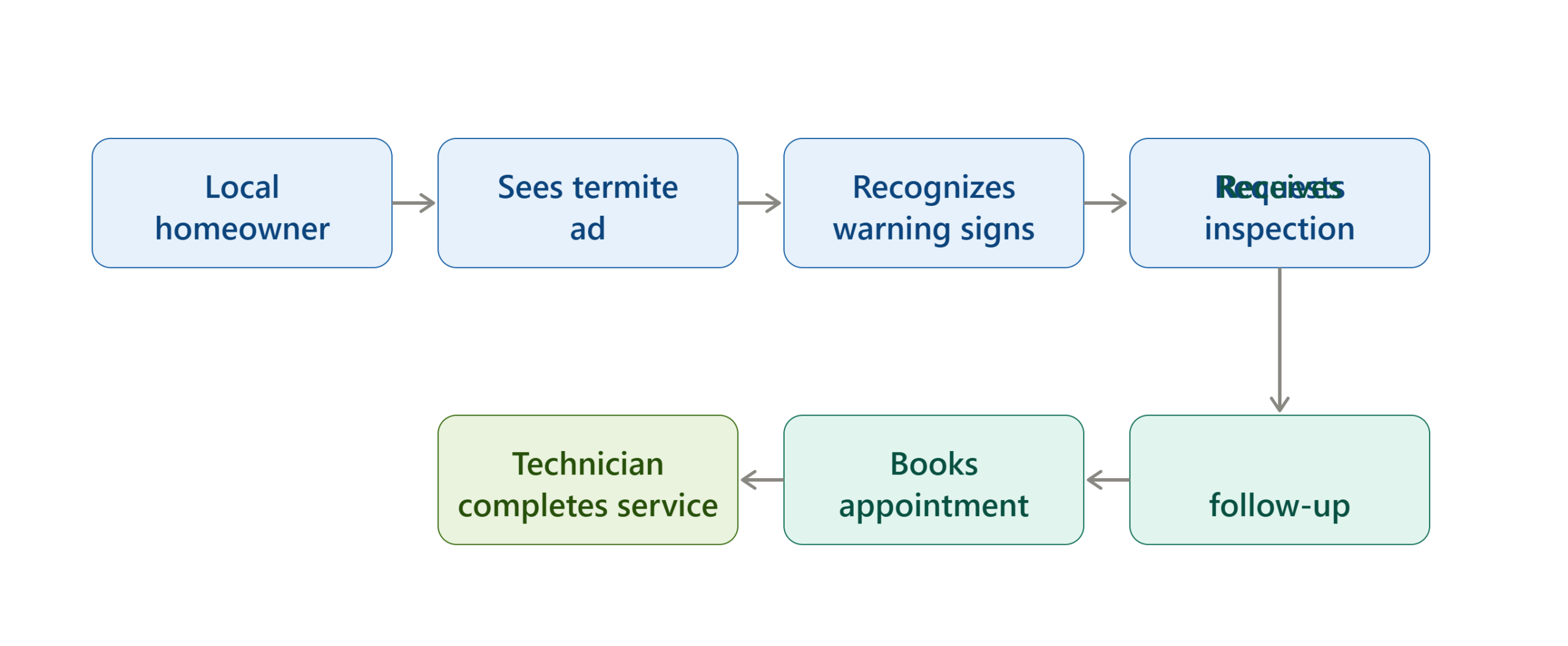
The campaign should therefore be designed around the final business outcome, not merely impressions or clicks.
A high click-through rate is useful only when those clicks eventually contribute to qualified leads and profitable jobs.
Before You Start Facebook Advertising for Pest Control
Before spending money, establish the economics and operational boundaries of the campaign.
Start with your service area. Advertising outside locations your technicians can efficiently serve creates wasted leads and poor route economics.
Next, choose the exact service being advertised. Avoid launching one campaign for every pest your company treats. Select a service with enough demand, adequate margins, available technician capacity, and a compelling customer problem.
You should also know:
- Average revenue per job
- Gross margin
- Lead-to-booking rate
- Booking-to-completed-job rate
- Repeat-service potential
- Customer lifetime value where measurable
- Maximum acceptable customer acquisition cost
- Technician capacity
- Areas you can service profitably
- Services you want to grow
Tracking should also be prepared before scaling spend. Depending on your funnel, this may include Meta’s measurement tools, analytics, CRM tracking, call tracking, and offline booking or revenue data.
The goal is simple: know whether an advertisement produced revenue, not merely whether somebody clicked it.
Which Pest Control Services Should You Advertise?
The best service to advertise is usually one that combines recognizable customer pain, sufficient demand, a profitable service value, and a clear reason to act.
| Pest-Control Service | Facebook Ad Angle | Typical Customer Trigger | Recommended CTA |
|---|---|---|---|
| Termite control | Protect the property from hidden damage | Warning signs or inspection concern | Book Inspection |
| Rodent control | Stop noises, droppings, and entry problems | Evidence of mice or rats | Request Inspection |
| Mosquito control | Make outdoor areas more comfortable | Seasonal mosquito activity | Get Quote |
| Ant control | Stop recurring indoor ant activity | Visible ant trails | Request Service |
| Cockroach control | Address recurring infestation | Sightings indoors | Get Help |
| Bed bug treatment | Professional inspection and treatment | Bites or suspected infestation | Book Inspection |
| General pest control | Ongoing household protection | Multiple recurring pests | Get Quote |
| Recurring prevention | Prevent future pest activity | Desire for year-round coverage | View Plan |
These are campaign frameworks, not universal performance rankings. Local pest pressure, climate, regulation, competition, pricing, and seasonality can change which service produces the strongest economics.
How to Create Facebook Ads for Pest Control Companies
A profitable campaign begins before the first advertisement is published. Build the campaign around a service, customer problem, conversion action, and measurable business result.
Step 1 — Choose One Primary Campaign Goal
Decide what result matters most.
For most pest-control businesses, the useful outcomes are qualified inquiries, calls, quote requests, inspections, appointments, or completed bookings.
Do not optimize the strategy around engagement simply because likes and comments are inexpensive. Engagement can support awareness, but it does not automatically translate into revenue.
Define one primary conversion for the campaign.
For example:
Primary conversion: inspection request
Secondary conversion: phone call
Business outcome: completed termite-treatment customer
This hierarchy makes later optimization much easier.
Step 2 — Select a High-Intent Pest Problem
Build each campaign around a clear customer problem rather than the company itself.
Weak positioning:
“Professional pest-control company serving your area.”
Stronger positioning:
“Hearing scratching in the walls at night? Find out where rodents may be entering your home.”
The second approach starts with a recognizable symptom.
Useful hooks include:
- Seeing ants in the kitchen?
- Hearing movement in the attic?
- Worried about termite activity?
- Mosquitoes taking over the yard?
- Cockroaches keep coming back?
- Need year-round pest protection?
Problem-first advertising helps a scrolling homeowner quickly decide whether the advertisement is relevant.
Step 3 — Define the Service Area Carefully
Target only areas the business can serve profitably.
A large audience is not automatically better for a local service company. A lead 60 miles from the nearest technician may look good in Ads Manager but become expensive operationally.
Build geography around:
- Actual service boundaries
- Technician coverage
- Travel time
- Route density
- Local licensing or operating restrictions
- Profitable ZIP/postal codes or areas where appropriate
- Areas with sufficient customer value
A multi-location company should consider separating materially different markets so performance can be evaluated independently.
This also makes ad copy more locally relevant.
Step 4 — Create an Offer Worth Responding To
A Facebook user may not have planned to contact a pest-control company today. The offer needs to create a reason to act.
Possible offers include:
- Pest inspection
- Quote request
- Seasonal treatment package
- New-customer offer
- Recurring prevention plan
- Pest-specific assessment
- Limited seasonal promotion
Avoid discounts that destroy margin merely to produce cheap form submissions.
The best offer creates qualified urgency, not artificial urgency.
Any price, guarantee, discount, certification, response time, or claim in the advertisement should accurately reflect what the business provides and comply with applicable advertising rules.
Step 5 — Choose the Right Conversion Path
Pest-control advertisers have several possible lead paths.
Instant form: Useful when reducing friction is important. The prospect submits information inside Meta’s environment.
Landing page: Useful when the service requires more explanation, trust signals, qualification, pricing context, or detailed tracking.
Phone call: Useful for urgent services when prospects prefer immediate assistance.
Messaging: Useful where supported and when the company has staff available to respond quickly.
The best option depends on service urgency and operational capability.
Do not send every campaign automatically to the homepage. A dedicated pest-specific landing page generally gives the visitor a clearer continuation of the advertisement.
Step 6 — Build Pest-Control Creative That Stops the Scroll
The creative should communicate the pest problem almost instantly.
Useful creative formats include:
- Technician at work
- Pest entry-point demonstration
- Inspection footage
- Short educational video
- Before-and-after treatment context
- Customer testimonial where permission is available
- Local team photo
- Pest-specific image
- Seasonal prevention video
- Simple homeowner checklist
Avoid unnecessarily disturbing imagery. The objective is to make the problem recognizable, not make the advertisement unpleasant.
For Reels placements, Meta recommends creative designed for the vertical environment. Meta reports that 9:16 video with audio and key messages inside the safe zone can improve Reels performance compared with unadapted image creative in its testing, although those results should not be assumed to represent pest control specifically.
Step 7 — Write Direct Ad Copy
Pest-control ad copy does not need to be complicated.
A useful structure is:
Problem → Consequence → Solution → Proof → Action
For example:
Noticing ants around the kitchen?
Recurring ant activity can indicate that the visible ants are only part of the problem. Our local pest-control team can inspect the affected areas and recommend an appropriate treatment plan.
Request an inspection today.
The message tells the reader exactly why the advertisement matters and what to do next.
Avoid unsupported fear-based claims or exaggerated guarantees.
Step 8 — Build a Conversion-Focused Landing Page or Form
The post-click experience should continue the same promise made in the advertisement.
A termite advertisement should lead to termite-specific information, not a generic homepage covering termites, rodents, mosquitoes, wildlife, commercial pest control, careers, and company history.
A useful landing page normally contains:
- Clear service headline
- Location/service-area relevance
- Short explanation of the problem
- Main benefits
- Trust signals
- Reviews or testimonials where legitimately used
- Simple lead form
- Phone option
- Clear CTA
- Mobile-friendly layout
Page speed matters as well.
In the June 2026 third-party pest-control advertising audit, mobile landing-page performance varied dramatically across advertisers. The dataset reported an average mobile Largest Contentful Paint of 10.29 seconds across 138 scored pest-control pages, while only 10.9% fell into the audit’s “fast” category below 2.5 seconds.
That represents an important opportunity: a fast, focused mobile experience can remove friction competitors may still tolerate.
Step 9 — Set Up Conversion Tracking
Tracking should connect advertising activity with real outcomes.
Where appropriate, implement Meta measurement tools such as the Meta Pixel and/or Conversions API, alongside your analytics and CRM systems.
Track meaningful events such as:
- Form submission
- Qualified lead
- Phone inquiry
- Appointment
- Inspection
- Booked job
- Completed service
- Revenue
Do not stop at “lead.”
If Campaign A generates 30 leads but only two booked customers while Campaign B generates 18 leads and seven booked customers, Campaign B may be far more valuable despite having the higher cost per lead.
Step 10 — Launch Multiple Creative Variations
Avoid putting the entire campaign behind one advertisement.
Test materially different ideas.
For example:
Creative A: technician inspection
Creative B: pest/problem close-up
Creative C: homeowner-focused video
Creative D: testimonial or local proof
You can also test different hooks:
Hook A: problem recognition
Hook B: prevention
Hook C: seasonal urgency
Hook D: offer
Change one major variable at a time when you need a clean comparison.
Step 11 — Follow Up With Leads Quickly
Lead generation is only half the system.
Facebook prospects may be earlier in the buying journey than people actively searching for an exterminator. Slow follow-up gives them time to forget the advertisement, contact another provider, or decide the problem can wait.
Create a consistent workflow:
Lead submitted → Confirmation → Fast human follow-up → Qualification → Appointment → Reminder → Service → Review/retention process
Your team should know which campaign produced the lead and which pest problem the person selected.
Do not force the customer to repeat information you already collected.
Step 12 — Optimize for Booked Customers, Not Cheap Leads
Review campaign performance using business metrics.
Useful measurements include:
| Metric | What It Shows |
|---|---|
| Cost per lead | Cost to generate an inquiry |
| Qualified lead rate | Percentage of leads that fit the service |
| Contact rate | Percentage successfully reached |
| Booking rate | Percentage that schedule service |
| Show rate | Percentage that keep the appointment |
| Cost per booked job | Actual acquisition efficiency |
| Average job value | Revenue generated per job |
| Customer acquisition cost | Cost to acquire a paying customer |
| Customer lifetime value | Long-term customer economics |
| ROAS/revenue attribution | Revenue relative to advertising spend |
The cheapest lead source is not necessarily the most profitable.
What Do Successful Pest-Control Companies Do on Facebook?
A useful 2026 competitive snapshot comes from PipelineOn’s audit of active U.S. pest-control advertisers in the Meta Ads Library.
| Company | Active Ads in Audit | Main Destination Reported | Meta Pixel Reported |
|---|---|---|---|
| Plunkett’s Pest Control | 70 | Website page | No |
| Atticare | 37 | Facebook Instant Form | No; CAPI reported |
| Dynasty Pest Control | 26 | Homepage | Yes |
| HomeTeam Pest Defense | 23 | Homepage | Yes |
| Brooks Pest Control | 21 | Facebook Instant Form | No |
| That Guy Services Inc. | 19 | Phone CTA | No |
| Truly Nolen Pest & Termite Control | 16 | Phone CTA | Yes |
| All Solutions Pest Control | 14 | Facebook Instant Form | Yes |
| Nectar Pest Control | 12 | Website page | Yes |
| NoCo Pest Solutions | 12 | Dedicated landing page | Yes |
Source note: These figures come from a third-party June 2026 snapshot of the Meta Ads Library and associated landing pages. They represent active ads observed at that time, not advertising spend, profitability, lead quality, or current live-ad counts.
The most useful lesson is not which company had the most advertisements.
It is that established advertisers use different conversion paths—forms, websites, calls, and landing pages. There is no single universal pest-control funnel. Each business should test the path that produces the lowest sustainable cost per qualified booked customer.
Facebook Instant Forms vs. Landing Pages for Pest Control
Neither option is automatically better.
| Factor | Instant Form | Landing Page |
|---|---|---|
| User friction | Lower | Usually higher |
| Speed | Fast | Depends on website |
| Detailed education | Limited | Strong |
| Qualification | Moderate | Highly customizable |
| Trust-building space | Limited | Strong |
| Website required | No | Yes |
| Best for | Simple lead capture | Higher-consideration services |
| Main risk | Low-intent submissions | Drop-off before conversion |
Use an Instant Form when speed and simplicity matter.
Use a dedicated landing page when the customer needs stronger proof, detailed service information, qualification, or explanation before requesting service.
The best decision comes from measuring qualified bookings, not raw form completion.
How Much Should Pest Control Companies Spend on Facebook Ads?
There is no universally correct daily budget for pest-control Facebook advertising. Costs vary by country, city, service, competition, season, audience, creative, conversion method, and campaign quality. Rather than copying an industry budget, work backward from customer economics.
Suppose a company determines that it can sustainably spend $180 to acquire one new customer. If 25% of qualified leads become paying customers:
Maximum sustainable qualified-lead cost = $180 × 25% = $45
That creates a useful benchmark.
If the campaign generates $25 leads but almost none are qualified, the apparent CPL is misleading. Conversely, a $55 lead could still be profitable if it produces a strong booking rate and valuable recurring customer.
Budget decisions should therefore be based on:
Lead cost → Qualification → Booking → Completed job → Revenue → Margin
not cost per lead alone.
How to Verify Your Facebook Ads Are Working
A campaign is working when it consistently produces economically acceptable business outcomes. Do not verify performance using likes or clicks alone.
Check the complete funnel:
Ads delivered → Clicks/forms/calls → Leads → Qualified leads → Appointments → Completed jobs → Revenue
Then compare campaign records with CRM, call, booking, and revenue data.
Look for discrepancies.
- If Meta shows 50 leads but your team can locate only 35, investigate the tracking and intake process.
- If you received 50 legitimate leads but only reached 15, advertising may not be the primary problem. Follow-up could be the bottleneck.
- If leads answer but live outside your service area, revisit targeting and qualification.
Verification should tell you where the funnel breaks, not merely whether the ad received attention.
What to Do When Pest-Control Facebook Ads Do Not Work
Poor Facebook ad results normally originate from one of several layers of the funnel.
| Problem | Likely Cause | Recommended Action |
|---|---|---|
| High impressions, few clicks | Weak creative or message | Test stronger pest-specific hooks |
| Clicks but few leads | Poor offer or landing-page friction | Improve message match, speed, form, and CTA |
| Many cheap leads, poor quality | Form is too easy or targeting/offer is broad | Add useful qualification questions |
| Leads do not answer | Slow follow-up or low intent | Contact faster and improve confirmation workflow |
| Leads outside service area | Geography or intake rules are too broad | Tighten locations and qualification |
| Leads book but do not show | Weak appointment process | Add confirmation and reminders |
| Good leads but expensive | Creative fatigue or market competition | Test new creative and offers |
| Campaign gets customers but appears unprofitable | Incomplete revenue attribution | Track completed jobs and customer value |
Diagnose the earliest broken stage first. If nobody clicks, changing the sales team’s call script will not fix the campaign.
If clicks are strong but appointments are weak, replacing every advertisement may not solve the real problem either.
Facebook Ads vs. Google Ads for Pest Control
Facebook and Google should not be treated as interchangeable advertising channels.
| Factor | Facebook/Meta Ads | Google Search/Local Intent Ads |
|---|---|---|
| Primary behavior | Browsing/discovery | Active searching |
| Typical intent | Lower to medium | Medium to very high |
| Main strength | Demand creation and retargeting | Demand capture |
| Creative importance | Very high | Important but different |
| Visual storytelling | Strong | More limited in Search |
| Seasonal awareness | Strong | Strong when searches already exist |
| Urgent pest problem | Can work | Often particularly strong |
| Preventive campaigns | Strong opportunity | Depends on search demand |
| Retargeting | Strong | Available through Google’s ecosystem |
For many pest-control businesses, the best strategy is not Facebook or Google. It is assigning each channel a different job.
Use search-focused advertising to capture immediate demand. Use Meta to create awareness, promote seasonal or preventive services, test offers, and re-engage eligible prospects.
Common Facebook Advertising Mistakes Pest Control Companies Should Avoid
- The first mistake is advertising every service in one generic campaign. A homeowner worried about mice responds differently from someone concerned about termites.
- The second is optimizing for cheap leads. Low CPL looks impressive in a report but means little when leads cannot be contacted or never book.
- The third is using a generic homepage as the destination for every campaign. The landing experience should continue the promise made by the advertisement.
- The fourth is weak geographic control. Local service businesses should judge advertising geography using both marketing performance and technician economics.
- The fifth is ignoring mobile performance. Facebook and Instagram traffic often reaches the business through mobile devices, making a slow or awkward mobile page a major source of friction.
- The sixth is relying on one creative indefinitely. Pest seasons change, competitors introduce new messages, and audiences can become familiar with repeated advertisements.
- The seventh is failing to connect advertising data with completed jobs. Without downstream tracking, marketers can optimize for the wrong lead source.
- Finally, avoid copying competitors blindly. An advertisement visible in the Meta Ads Library proves that it is running; it does not prove profitability.
Expert Insights for Better Pest-Control Facebook Ads
The strongest optimization opportunity is often message-to-market timing.
Instead of running the same “pest control near you” creative all year, build a seasonal creative calendar based on actual local pest activity.
A mosquito campaign becomes more relevant as outdoor mosquito pressure rises. Rodent messaging can become more relevant when local conditions drive rodents indoors. Termite campaigns can be timed around periods when homeowners are more likely to notice signs of activity.
A second opportunity is service segmentation.
Separate high-value services from routine offers when their economics differ substantially. A campaign generating expensive but profitable termite customers should not automatically be judged against a low-ticket one-time treatment using the same CPL target.
Third, optimize around route density, not just geographic lead volume.
Ten customers clustered around existing routes can be more operationally valuable than ten equally priced customers scattered across a large region.
Fourth, create a creative learning system.
Track each creative by:
Pest → Hook → Format → Offer → Audience → Lead quality → Booking rate
Over time, this produces far more useful information than simply labeling ads “Ad 1” and “Ad 2.”
Finally, use authentic local creative where possible. A September 2026 report highlighted a South Australian pest-control operator whose deliberately simple, personal Facebook community-group advertisement generated strong engagement and at least ten bookings within a week. It was not a controlled paid-ad experiment, so the result should not be generalized, but it illustrates an important creative principle: local service advertising does not always need polished corporate production to feel credible.
Facebook Ads Implementation Checklist for Pest Control Companies
Before Launch
- Define the pest-control service being promoted.
- Confirm profitable service locations.
- Calculate acceptable customer acquisition cost.
- Choose the main conversion action.
- Create a pest-specific offer.
- Prepare multiple creative concepts.
- Build the lead form or dedicated landing page.
- Confirm mobile usability and page speed.
- Configure appropriate conversion tracking.
- Prepare lead-response procedures.
During the Campaign
- Monitor delivery and spend.
- Check lead quality.
- Review geographic lead distribution.
- Monitor contact and booking rates.
- Compare creatives.
- Record which pest/service each lead requested.
- Watch for creative fatigue.
- Avoid major decisions based on tiny data samples.
After Leads Arrive
- Follow up promptly.
- Confirm the lead is inside the service area.
- Record whether the lead qualifies.
- Track appointment status.
- Record completed jobs.
- Attribute revenue where possible.
- Calculate cost per booked and completed customer.
- Use actual customer outcomes to guide the next optimization cycle.
Frequently Asked Questions
Are Facebook ads worth it for pest-control companies?
Facebook ads can be worthwhile when a pest-control company has a defined service area, compelling pest-specific offer, strong creative, fast lead follow-up, and accurate booking attribution. Profitability should be evaluated using qualified customers and revenue rather than clicks or raw leads.
What type of Facebook ad works best for pest control?
There is no universal winning format. Pest-specific videos, technician footage, problem-recognition creative, local proof, seasonal messages, and clear service offers are strong starting points. Test them against actual booking results.
Should pest-control companies use Facebook Lead Ads?
Instant Forms can reduce the friction involved in requesting information and are already used by active pest-control advertisers. However, businesses should monitor qualification and booking rates because an easy form can also generate lower-intent inquiries.
Is Facebook better than Google Ads for pest control?
Neither is universally better. Google can capture people already searching for pest-control help, while Facebook can create demand and reach prospects before they search. Companies should compare cost per qualified booked customer and use each platform for the role it performs best.
Should I advertise every pest-control service in one campaign?
Usually not. Separating materially different services makes the message more relevant and lets you measure the economics of termite, mosquito, rodent, ant, or other campaigns independently.
How quickly should pest-control companies contact Facebook leads?
As quickly as the business can reliably support. Social leads may not have the same immediate intent as someone actively searching for an exterminator, so a structured and prompt response process helps prevent interest from fading.
Can I run Facebook pest-control ads without a website?
Some Meta lead-generation paths can collect inquiries without requiring a traditional website. A website or dedicated landing page remains useful when prospects need detailed service information, trust signals, qualification, or additional conversion paths.
How do I know whether my Facebook ads are profitable?
Track the entire funnel from ad spend to qualified leads, appointments, completed jobs, revenue, and ideally customer lifetime value. A campaign with a higher CPL can outperform a cheaper campaign when its leads book at a substantially higher rate.
Read More:
Key Takeaways
Facebook ads for pest-control companies work best when they are built around a specific pest problem, local audience, clear offer, strong creative, simple conversion path, rapid follow-up, and complete revenue tracking.
Do not judge a campaign by impressions, likes, or inexpensive form submissions.
Measure:
Ad spend → Qualified leads → Bookings → Completed jobs → Revenue
Meta is especially valuable for creating awareness, promoting seasonal and preventive services, testing local offers, and retargeting eligible audiences. Search advertising can complement it by capturing customers who are already looking for an exterminator.
The most effective pest-control advertising strategy in 2026 is therefore not about finding one magical ad format. It is about building a measurable acquisition system and continually improving the weakest part of that system.