

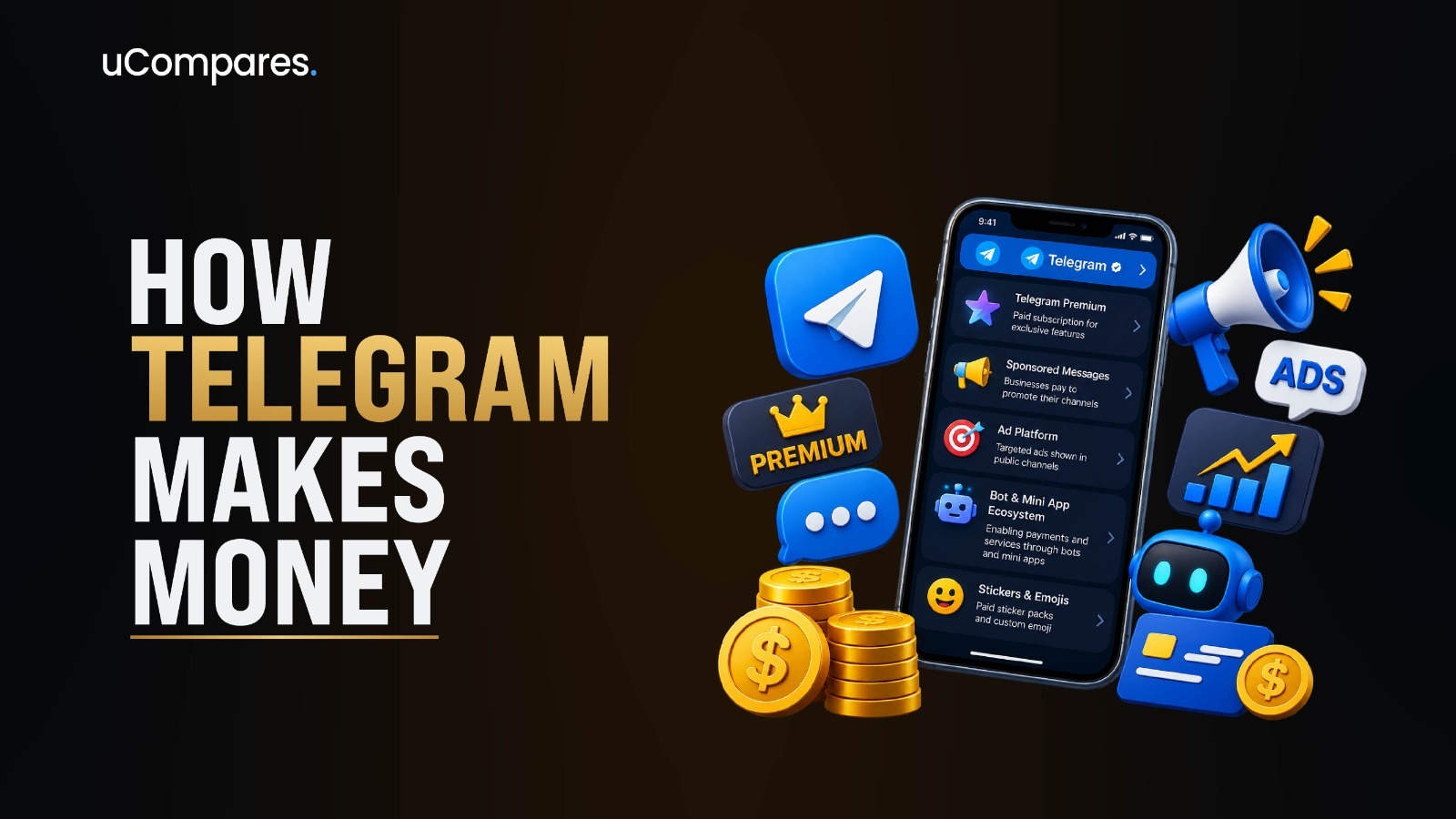
Telegram makes money primarily through Telegram Premium subscriptions, advertising in public channels, and monetization around Telegram Stars, digital goods, bots, mini apps, and other paid features. Telegram also operates paid business and platform services, while creators and channel owners can participate in revenue-generating features such as sponsored-message revenue sharing, paid media, subscriptions, and paid messages.
Unlike many advertising-driven social platforms, Telegram says it does not sell user data or place advertisements in private chats and groups. Its advertising system is primarily designed around public channels and contextual sponsored messages.
The most important change in Telegram’s monetization strategy is that it has evolved from a simple messaging app into a broader communication, creator, advertising, payments, and mini-app ecosystem.
How Does Telegram Make Money?
Telegram uses a freemium platform model: its core messaging service remains free, while additional features and commercial activity create opportunities for revenue.
The major monetization mechanisms can be summarized as follows:
| Revenue / Monetization Stream | How It Works | Who Pays? | Telegram’s Role |
|---|---|---|---|
| Telegram Premium | Users pay for additional features | Users | Subscription provider |
| Sponsored Messages / Telegram Ads | Advertisers pay to promote messages in eligible public channels | Advertisers | Advertising platform |
| Telegram Stars | Users purchase virtual Stars for digital goods, services and creator interactions | Users | Payment and digital-commerce infrastructure |
| Paid digital goods | Bots and mini apps sell digital products and services | Users | Platform/payment ecosystem |
| Paid messages | Users can charge for receiving messages | Users | Payment infrastructure and commission |
| Creator monetization | Channels earn from ads, subscriptions, paid media and other features | Users/advertisers | Monetization platform |
| Business/platform services | Businesses use Telegram’s commercial and verification infrastructure | Businesses/developers | B2B platform |
| TON/Fragment ecosystem | Telegram integrates blockchain-based assets and services into its ecosystem | Users/developers | Distribution and ecosystem infrastructure |
Not every dollar moving through Telegram’s ecosystem should automatically be classified as Telegram’s revenue. Some payments are transferred to creators or developers, while Telegram provides the infrastructure that enables those transactions.
What Is Telegram’s Business Model?
Telegram’s business model is based on keeping basic communication free while monetizing premium users, advertisers, creators, developers, businesses, and digital commerce.
Telegram’s own FAQ identifies two foundational monetization mechanisms: Sponsored Messages, introduced in 2021, and Telegram Premium, introduced in 2022. The company says these revenue streams help cover infrastructure and developer costs.
Since then, Telegram has expanded its monetization architecture considerably.
The platform now supports:
- Paid subscriptions
- Sponsored advertising
- Telegram Stars
- Paid photos and videos
- Paid messages
- Digital goods
- Mini-app purchases
- Creator rewards
- Affiliate programs
- Gifts and collectible digital items
- Business services
- Bot-based commerce
This makes Telegram’s modern business model less dependent on one traditional advertising product.
Why Does Telegram Need to Make Money?
Running a global messaging platform is expensive.
Telegram has to pay for:
- Servers and cloud infrastructure
- Bandwidth
- Data storage
- Security engineering
- Software development
- Customer support
- Content and abuse-management systems
- Product development
- Payments infrastructure
- Business and developer infrastructure
Telegram’s official FAQ explains that its monetization streams help fund infrastructure costs and developer salaries.
For many years, Telegram’s founder Pavel Durov personally financed the company. As the platform grew, however, Telegram needed recurring commercial mechanisms that could support the service without making basic messaging dependent on advertising.
That is why Telegram gradually moved toward subscriptions, privacy-conscious advertising, and platform commerce.
How Does Telegram Premium Make Money?
Telegram Premium is Telegram’s subscription-based monetization model.
Users can continue using Telegram for free, but Premium subscribers receive additional features and capabilities.
Telegram originally launched Premium in 2022 as a way for users to support the platform while receiving additional features. Telegram’s official FAQ still identifies Premium as one of its core monetization mechanisms.
How the Premium model works
The process is straightforward:
- Telegram provides its core service for free.
- It creates additional features that appeal to power users.
- Users who want those features purchase Premium.
- Telegram receives recurring subscription revenue.
- That revenue helps fund the platform and its development.
This is a classic freemium model.
The advantage is that Telegram does not need to charge every user.
Instead, a smaller percentage of highly engaged users can pay for additional value while everyone else continues using the basic service.
Why Premium matters
Subscription revenue is strategically important because it is:
- Recurring
- More predictable than advertising
- Directly connected to user demand
- Less dependent on ad inventory
- Compatible with Telegram’s privacy positioning
It also gives Telegram a way to monetize users without putting traditional advertisements into private conversations.
How Do Telegram Ads Make Money?
Advertising is Telegram’s second major monetization pillar.
Telegram introduced Sponsored Messages in 2021. Its advertising system allows advertisers to purchase sponsored messages that appear in eligible public channels. Telegram’s official advertising documentation currently describes sponsored messages in public one-to-many channels with at least 1,000 subscribers.
How Telegram’s advertising model works
The basic flow is:
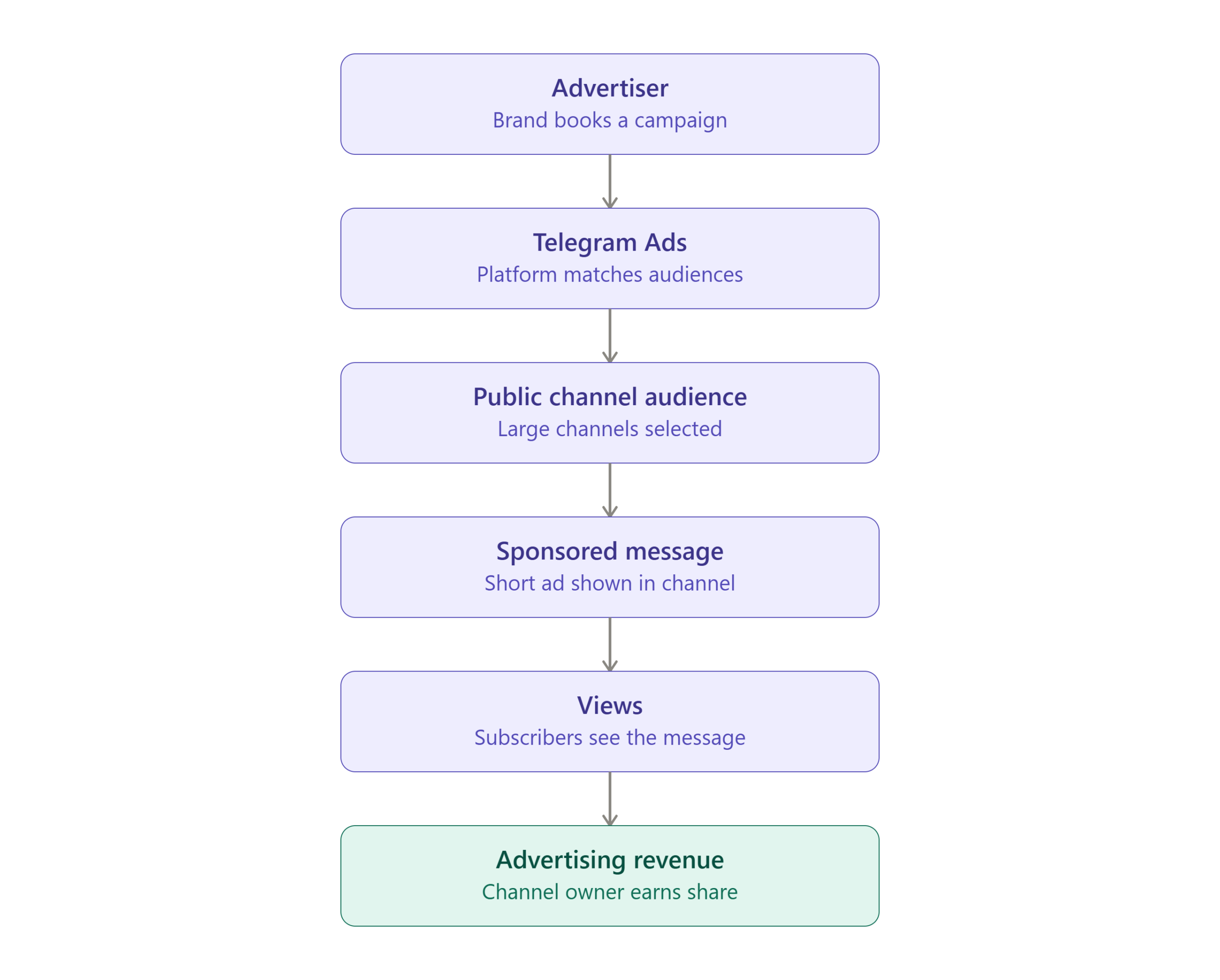
Advertisers can:
- Create sponsored messages
- Set advertising budgets
- Choose target channels
- Set CPM pricing
- Monitor campaign performance
Telegram’s current advertising documentation states that advertisers set a CPM, meaning the price paid for 1,000 views, and that the minimum CPM is 0.1 Toncoin.
Does Telegram show ads in private chats?
No, according to Telegram’s official FAQ.
Telegram says it does not place ads in private chats and groups and does not sell user data to advertisers.
This distinction is important because Telegram’s advertising model is different from the highly personalized advertising model used by many major social platforms.
Are Telegram ads targeted using private messages?
Telegram’s public explanation emphasizes privacy-conscious, contextual advertising rather than using private-message content for ad targeting.
The basic idea is:
Public channel context → relevant sponsored message
rather than:
Private conversation → personal profile → behavioral ad targeting
This is one of the central differences between Telegram’s stated advertising philosophy and traditional surveillance-oriented advertising models.
How Does Telegram Share Ad Revenue With Channel Owners?
Telegram does not keep all advertising revenue generated by eligible channels.
In April 2024, Telegram announced that owners of public channels with at least 1,000 subscribers could receive 50% of the revenue from ads displayed in their channels.
Telegram’s current technical documentation continues to state that channel and bot owners can receive 50% of advertising revenue generated through ads displayed in their channels or bots.
This creates a two-sided advertising marketplace:
Advertisers pay Telegram → Telegram displays ads → Channels generate views → Eligible channel owners receive a share
This model gives creators a financial incentive to build large, engaged audiences.
It also benefits Telegram because successful channels create more valuable advertising inventory.
Why the revenue-sharing model matters
It creates a network effect:
More creators → More channels → More content → More users → More views → More advertising inventory → More creator revenue → More incentive to create content
That is considerably more sophisticated than simply selling advertisements inside a messaging application.
How Do Telegram Stars Make Money?
Telegram Stars are a virtual currency used inside Telegram’s ecosystem.
They allow users to purchase digital goods and services from bots and mini apps and interact financially with creators and other platform features. Telegram launched Stars in 2024 as part of its digital-commerce infrastructure.
For example, users can spend Stars on:
- Digital products
- Games
- Bot services
- Paid media
- Creator interactions
- Gifts
- Subscriptions
- Other digital experiences
Telegram’s Bot Payments documentation confirms that digital goods and services inside Telegram are paid for using Stars.
Why Stars are important to Telegram
Stars transform Telegram from simply a communication platform into a transaction platform.
Instead of users only sending messages, they can now:
Discover → Purchase → Consume → Support → Subscribe → Trade
without leaving the Telegram ecosystem.
This creates additional economic activity around the platform.
How Do Bots and Mini Apps Contribute to Telegram’s Revenue Model?
Telegram’s bot and mini-app ecosystem is one of the most important long-term parts of its business model.
Bots and mini apps can provide:
- Games
- AI services
- Shopping
- Digital products
- Productivity tools
- Entertainment
- Financial services
- Subscription services
- Content
- Business tools
Telegram allows developers to sell digital goods and services through Stars.
This creates a marketplace-style business model.
Example
Imagine a developer creates an AI image-generation mini app.
A user:
- Opens the mini app.
- Purchases Stars.
- Spends Stars on image generation.
- Receives the generated image.
- The developer earns rewards.
- Telegram operates the infrastructure connecting the user and developer.
The developer gets a commercial distribution channel, while Telegram strengthens its ecosystem and monetization infrastructure.
How Do Telegram Creators Make Money?
Telegram increasingly allows creators to monetize audiences directly.
This includes:
- Ad revenue sharing
- Star reactions
- Paid subscriptions
- Paid media
- Paid messages
- Suggested posts
- Affiliate programs
- Gifts
Telegram introduced Star Reactions so users can send Stars directly to channel owners. Telegram stated that channel owners receive 100% of the Stars from Star Reactions and can convert them into rewards or use them for advertising.
Creators can also create paid subscription links that charge users monthly in Stars for access to exclusive channels.
Paid photos and videos provide another monetization mechanism: users pay Stars to unlock content published by creators.
This is important because Telegram is not only monetizing users itself; it is building an ecosystem in which users, creators, advertisers, and developers can all transact.
Does Telegram Make Money From Paid Messages?
Yes, Telegram has also introduced monetization around paid messages.
A user, channel, or group can configure a fee for incoming messages. People who want to send a message must pay the required amount in Stars.
Telegram’s API documentation confirms that paid messages generate Stars revenue and that the received amount is calculated using a Telegram-defined commission.
This feature solves two problems simultaneously:
- For recipients: It can reduce unwanted messages.
- For Telegram: It creates another transaction-based monetization mechanism.
- For senders: It provides a way to demonstrate that a message is important enough to justify payment.
How Does Telegram Make Money From Digital Goods?
Telegram has created infrastructure for buying and selling digital products inside the platform.
Examples include:
- Games
- Digital items
- Online services
- Media
- AI services
- Bot functionality
- Mini-app subscriptions
Telegram Stars provide the payment mechanism for these digital transactions.
The significance is larger than simply selling virtual currency.
Telegram is effectively creating a digital marketplace layered on top of its messaging network.
That creates multiple economic participants:
| Participant | What They Do |
| Users | Purchase Stars and digital products |
| Developers | Build bots and mini apps |
| Creators | Sell content and subscriptions |
| Advertisers | Purchase sponsored messages |
| Channel owners | Build audiences and earn monetization revenue |
| Telegram | Provides infrastructure and monetization tools |
Does Telegram Make Money From Gifts and Collectibles?
Telegram has expanded Stars into a broader digital-goods ecosystem involving gifts and collectible items.
Users can purchase gifts using Stars, while collectible gifts can be traded or sold through Telegram’s marketplace features. Telegram introduced collectible gifts in 2025 and subsequently expanded marketplace functionality.
Telegram has also introduced mechanisms allowing users to make offers for gifts using Stars or TON.
However, it is important not to treat every gift transaction as equivalent to direct Telegram revenue.
Transaction volume is not the same thing as company revenue.
Some value flows between users, creators, developers, or other ecosystem participants.
Does Telegram Make Money From Affiliate Programs?
Telegram has also introduced affiliate programs for mini apps.
Under these programs, users and channels can receive Stars when people use their referral links and make purchases in participating mini apps. Developers can choose what percentage of future revenue they share with affiliates.
This is primarily an ecosystem-growth mechanism.
The business logic is:
Developer creates product → Creator promotes it → User purchases → Developer earns revenue → Affiliate receives commission → Telegram facilitates the ecosystem
Affiliate programs can therefore increase commercial activity without requiring Telegram to rely entirely on traditional advertisements.
How Does TON Fit Into Telegram’s Business Model?
TON, or The Open Network, is closely connected to Telegram’s broader digital ecosystem.
Telegram uses blockchain-related infrastructure for areas such as:
- Toncoin rewards
- Digital collectibles
- Certain advertising payments
- Creator rewards
- Digital identities and usernames
- Web3 functionality
Telegram has stated that creators and developers can convert eligible Stars into Toncoin rewards, while Stars can also be used for Telegram advertising.
However, there is an important distinction:
TON is not simply another conventional Telegram revenue stream.
It is better understood as part of Telegram’s broader ecosystem strategy, where messaging, mini apps, digital assets, payments, advertising, and blockchain functionality intersect.
Does Telegram Make Money From Business Services?
Telegram is also moving beyond consumer messaging.
Businesses can use Telegram for:
- Customer communication
- Bots
- Automated services
- Business accounts
- Mini apps
- Verification
- Paid messaging
- Customer-facing workflows
Telegram launched a business verification platform that allows businesses to verify customer phone numbers through Telegram for a stated per-user fee.
This represents another potential B2B monetization layer.
The long-term significance is that Telegram does not need to monetize only individual consumers.
It can also monetize the businesses and developers that build commercial services on top of the platform.
What Is Telegram’s Most Important Revenue Stream?
Telegram does not publicly provide a complete, current official percentage breakdown of total revenue by category, so it would be misleading to state with certainty that one specific stream represents a particular percentage of the company’s 2026 revenue.
The safest conclusion is that Telegram has built a diversified monetization model centered on:
- Premium subscriptions
- Advertising
- Stars and digital commerce
- Creator monetization
- Developer and mini-app activity
- Business/platform services
- Blockchain-linked ecosystem activity
Third-party reports may provide revenue estimates, but these should be treated separately from Telegram’s own official disclosures.
Does Telegram Sell User Data to Make Money?
Telegram says it does not sell user data to advertisers.
Its official FAQ explicitly says that Telegram does not sell user data and does not place advertisements in private chats and groups.
This is a major part of Telegram’s monetization philosophy.
Instead of relying primarily on:
User data → behavioral profile → targeted advertising
Telegram emphasizes:
Premium subscriptions + contextual advertising + platform transactions
That does not mean Telegram has no commercial data or payment infrastructure. It means the company’s stated advertising model does not depend on selling users’ private communications to advertisers.
Does Telegram Charge Users to Use the App?
No. Telegram’s core messaging service remains free.
Telegram uses a freemium model.
Free users can use the core communication platform, while Premium subscribers pay for additional capabilities. Telegram’s own FAQ describes this approach as a way to keep the basic service free while generating sustainable revenue.
This distinction is important:
Free Telegram user ≠ non-monetizable user
A free user can still:
- View sponsored messages
- Purchase Stars
- Buy digital products
- Interact with monetized creators
- Use commercial mini apps
- Become a Premium subscriber later
The platform therefore monetizes user activity, not simply account registration.
Telegram’s 2026 Monetization Flywheel
Telegram’s current model can be understood as a flywheel:
More Users
↓
More Channels, Creators, Bots & Mini Apps
↓
More Content & Services
↓
More User Engagement
↓
More Premium Subscribers + Ad Views + Transactions
↓
More Creator & Developer Earnings
↓
More Incentive to Build on Telegram
↓
More Users and Engagement
This is arguably more important than any individual revenue stream.
Telegram is trying to create an ecosystem in which communication generates commerce and commerce strengthens communication.
Telegram Revenue Model vs. Traditional Social Media
| Feature | Telegram | Traditional Ad-Heavy Social Platforms |
| Core messaging | Free | Usually free |
| Premium subscription | Yes | Varies |
| Public-channel advertising | Yes | Yes |
| Private-chat advertising | Telegram says no | Varies |
| Selling user data | Telegram says no | Business models vary |
| Creator ad revenue sharing | Yes | Common |
| Virtual currency | Telegram Stars | Platform-dependent |
| Digital goods | Yes | Yes on many platforms |
| Mini-app ecosystem | Strong | Varies |
| Blockchain integration | Significant | Varies |
| Paid creator subscriptions | Yes | Common |
| Paid messages | Yes | Less common |
| Bot commerce | Yes | Varies |
The important difference is that Telegram is increasingly monetizing the ecosystem around communication, rather than simply monetizing attention through advertisements.
How Telegram’s Monetization Has Changed
Telegram’s monetization strategy did not appear all at once.
Phase 1: Founder-Funded Telegram
For much of its early history, Telegram was largely funded by Pavel Durov.
The focus was on user growth, infrastructure, privacy, and product development.
Phase 2: Sponsored Messages
Telegram introduced Sponsored Messages in 2021, creating an advertising mechanism focused on public channels.
Phase 3: Telegram Premium
Telegram Premium launched in 2022, introducing recurring subscription revenue.
Phase 4: Stars and Digital Commerce
Telegram introduced Stars in 2024, allowing users to purchase digital goods and services through bots and mini apps.
Phase 5: Creator Economy
Telegram expanded Star reactions, subscriptions, paid media, and other creator monetization tools.
Phase 6: Broader Platform Economy
By 2025–2026, Telegram had expanded further into gifts, marketplaces, affiliate programs, paid messages, business tools, AI-related services, and other commercial functionality.
The result is a much broader business model than the Telegram of its early years.
What Telegram Does Not Rely On
Understanding what Telegram doesn’t do is just as useful as understanding its revenue streams.
According to Telegram’s official FAQ, the company does not:
- Put ads in private chats
- Put ads in private groups
- Sell user data to advertisers
- Charge everyone a mandatory subscription fee
Instead, Telegram monetizes selected parts of the ecosystem while maintaining free core communication.
Common Misconceptions About Telegram’s Revenue
Misconception 1: Telegram Makes Money Only From Premium
Reality: Premium is important, but Telegram has expanded into advertising, Stars, creator monetization, digital goods, business services, and other platform features.
Misconception 2: Every Star Purchased Becomes Telegram Revenue
Reality: Stars facilitate transactions between users, creators, developers, and Telegram. The value of Stars should not automatically be treated as Telegram’s net revenue.
Telegram’s developer terms specify reward values for Stars and separately describe their use for advertising credits, illustrating why Star purchases and Telegram revenue are not identical concepts.
Misconception 3: Telegram Ads Are Shown Everywhere
Reality: Telegram’s official FAQ says ads do not appear in private chats and groups. Its advertising documentation focuses on eligible public channels.
Misconception 4: Telegram Gives All Ad Revenue to Channels
Reality: Eligible channel and bot owners can receive 50% of advertising revenue, meaning Telegram retains the other portion before accounting for the broader economics of the advertising system.
Misconception 5: Telegram’s Funding and Revenue Are the Same Thing
Reality: Investments, bonds, founder funding, user payments, and operating revenue are different financial concepts. They should not be mixed when analyzing Telegram’s business model.
What Are the Main Advantages of Telegram’s Business Model?
Telegram’s approach provides several strategic advantages.
1. Diversified Monetization
Telegram does not have to rely exclusively on advertising.
2. Recurring Revenue
Premium subscriptions can provide recurring payments.
3. Creator Incentives
Revenue sharing encourages creators to build audiences.
4. Developer Incentives
Bots and mini apps give developers a way to build businesses inside Telegram.
5. Privacy Positioning
Telegram can monetize without relying on selling private conversations to advertisers.
6. Network Effects
More creators and developers make Telegram more useful, which can attract more users.
7. Transactional Revenue
Stars create opportunities to monetize activity that would otherwise remain non-commercial.
What Are the Risks in Telegram’s Monetization Model?
A diversified model does not eliminate risk.
Advertising Risk
Advertising revenue depends on advertiser demand, audience engagement, CPMs, and available inventory.
Subscription Risk
Premium revenue depends on convincing users that additional features are worth paying for.
Platform Risk
If creators or developers leave, the ecosystem becomes less valuable.
Regulatory Risk
Payments, cryptocurrencies, advertising, and digital goods are subject to changing regulations in different countries.
Blockchain Risk
TON-linked activities can be exposed to cryptocurrency-market volatility and regulatory uncertainty.
User Experience Risk
Too much monetization could damage the clean, private experience that helped Telegram attract users.
The key challenge is therefore monetizing activity without making the product feel overly commercial.
Expert Insight: Telegram Is Becoming a Platform, Not Just a Messenger
The most important development in Telegram’s business model is not simply the introduction of Premium or advertising.
It is the transformation of Telegram from a messaging application into a platform economy.
A traditional messaging app primarily creates value by connecting people.
Telegram increasingly creates additional value by connecting:
- Users
- Communities
- Creators
- Developers
- Advertisers
- Businesses
- Digital products
- Payment systems
- Mini apps
- Blockchain-based assets
That creates more opportunities for monetization at every layer.
In simple terms:
Telegram used to monetize the app.
Telegram increasingly monetizes the ecosystem around the app.
That distinction is crucial when analyzing Telegram in 2026.
How to Analyze Telegram’s Revenue Model Yourself
If you are researching Telegram for business, investment, marketing, or academic purposes, use this framework.
Step 1: Separate Users From Paying Users
Estimate how many people use the free product versus paid features.
Step 2: Identify Revenue Sources
Track:
Premium, Ads, Stars, Creator payments, Business services, Developer activity.
Step 3: Separate GMV From Revenue
Do not treat the total value of transactions as Telegram’s revenue.
Step 4: Examine Revenue Sharing
Determine how much goes to: Telegram, Creators, Developers, Advertisers, Payment providers.
Step 5: Evaluate Recurring vs. Variable Revenue
Premium subscriptions are more recurring, while advertising and transaction activity can fluctuate.
Step 6: Consider Regulatory Exposure
Pay particular attention to: Digital currencies, Payments, Advertising, Privacy, Business verification,Cross-border transactions
This framework gives a more accurate picture than simply asking, “How much money does Telegram make?”
Frequently Asked Questions (FAQs)
How does Telegram make money in 2026?
Telegram primarily monetizes through Premium subscriptions, sponsored advertising in public channels, Telegram Stars and digital transactions, creator monetization, and additional business and platform services.
Is Telegram free?
Yes. Telegram’s core messaging service remains free, while Premium and other optional paid features provide additional monetization opportunities.
Does Telegram sell user data?
Telegram says it does not sell user data to advertisers and does not show ads in private chats and groups.
Does Telegram make money from ads?
Yes. Telegram operates an advertising platform for sponsored messages in eligible public channels.
How much of Telegram ad revenue goes to channel owners?
Telegram states that eligible channel and bot owners can receive 50% of advertising revenue generated from ads displayed in their channels or bots.
What are Telegram Stars?
Telegram Stars are virtual items used for digital purchases and services inside Telegram, including transactions involving bots, mini apps, creators, and paid content.
Does Telegram make money from Telegram Stars?
Stars are part of Telegram’s broader digital-commerce and monetization infrastructure. However, the amount users spend on Stars should not automatically be treated as Telegram’s net revenue because Stars can be distributed as rewards to developers and creators and used for other platform purposes.
Can Telegram channels make money?
Yes. Eligible channels can earn from advertising revenue, while creators can also use Star reactions, subscriptions, paid media, and other monetization tools.
Can Telegram creators sell content?
Yes. Creators can publish paid photos and videos that users unlock using Telegram Stars.
Can Telegram users charge for messages?
Yes. Telegram supports paid messages, allowing eligible users, groups, and channels to require payment in Stars for incoming messages.
Does Telegram have a business model beyond advertising?
Yes. Telegram has built subscription, digital-commerce, creator, developer, business, and payment-related features in addition to advertising.
Does Telegram use TON?
TON and Toncoin are integrated into parts of Telegram’s broader ecosystem, including certain creator rewards, advertising-related functions, digital collectibles, and Web3 functionality.
Is Telegram’s exact revenue breakdown public?
Telegram’s official public materials explain its monetization mechanisms, but they do not provide a complete current percentage breakdown of total revenue by source. Third-party estimates should therefore be treated as estimates rather than official figures.
Final Takeaway
So, how does Telegram make money in 2026?
The answer is no longer simply “through Premium subscriptions and ads.”
Telegram has developed a multi-layer monetization ecosystem combining subscriptions, public-channel advertising, Stars, creator payments, paid content, bots, mini apps, digital goods, business services, and blockchain-linked functionality.
Its strategy is particularly notable because Telegram says it avoids selling user data and does not place advertising in private chats and groups. Instead, it monetizes optional premium features, public attention, transactions, and commercial activity around the platform.
The clearest way to understand Telegram’s 2026 business model is:
Free communication → large audience → creators and developers → commercial activity → subscriptions, advertising and transactions → revenue
That ecosystem approach is likely to remain more important than any single Telegram revenue stream.