

You cannot currently install Microsoft Copilot as a direct chatbot inside WhatsApp. Microsoft ended Copilot on WhatsApp on January 15, 2026, so older tutorials showing a Copilot WhatsApp number or QR-code setup are outdated.
You can still use Copilot with WhatsApp in three practical ways: use the Copilot mobile app alongside WhatsApp, use Copilot on the web alongside WhatsApp Web, or copy WhatsApp text into Copilot and paste the result back into WhatsApp. Microsoft currently supports Copilot through its mobile apps, web experience, Windows, and Mac.
You cannot currently add the official Copilot chatbot directly to a normal WhatsApp conversation. However, you can keep WhatsApp open and use Copilot separately to draft replies, rewrite messages, summarize text, translate content, generate ideas, or answer questions.
What Is Microsoft Copilot on WhatsApp?
Microsoft Copilot on WhatsApp was Microsoft’s former integration that allowed users to communicate with Copilot through the WhatsApp messaging platform.
The service launched in late 2024 and remained available until January 15, 2026. Microsoft subsequently discontinued the WhatsApp version and other third-party messaging integrations.
Today, “Microsoft Copilot on WhatsApp” should therefore be understood as a workflow rather than a currently available WhatsApp chatbot.
For example, you can: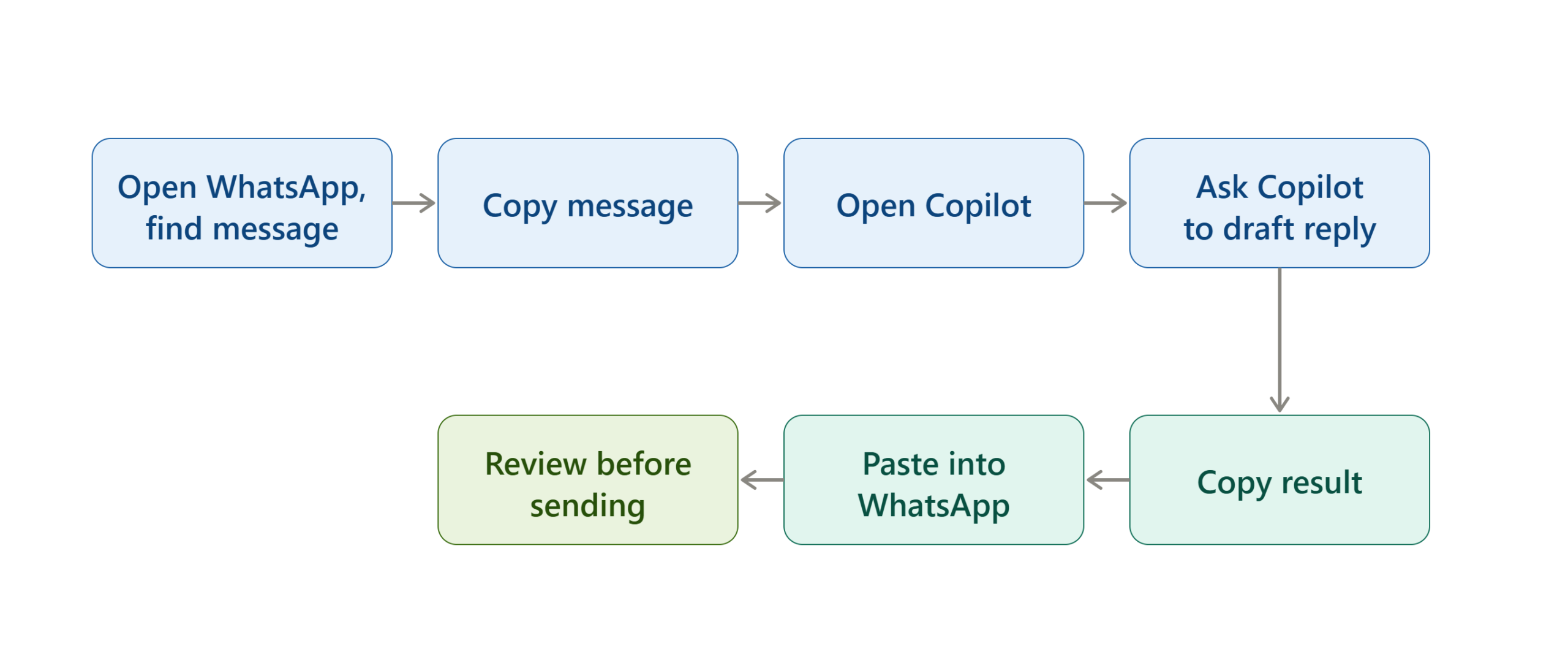
This gives you much of the same practical benefit without pretending that Copilot is still installed inside WhatsApp.
Can You Install Microsoft Copilot Directly on WhatsApp?
No. As of September 2026, there is no official Microsoft Copilot WhatsApp chatbot that users can install and continue using directly inside WhatsApp.
Microsoft’s official announcement states that Copilot on WhatsApp stopped functioning after January 15, 2026. Microsoft’s current Copilot pages now direct users toward the Copilot app and other Microsoft-supported surfaces.
This means you should be cautious with websites, videos, or posts that claim to provide a new official Copilot WhatsApp number or activation method.
What happened to the old Copilot WhatsApp method?
The old service was discontinued rather than merely hidden from the WhatsApp interface.
Microsoft specifically stated that Copilot would no longer be available on WhatsApp from January 15, 2026. The company attributed the change to WhatsApp’s updated platform policies concerning LLM chatbots.
Therefore, reinstalling WhatsApp, changing phones, clearing WhatsApp’s cache, or searching for the old Copilot contact does not restore the discontinued service.
Why Are Microsoft Copilot and WhatsApp No Longer Directly Connected?
The direct integration ended because of changes to WhatsApp’s platform policies.
Microsoft announced in November 2025 that WhatsApp would prohibit LLM chatbots beginning January 15, 2026. Microsoft consequently discontinued Copilot’s WhatsApp experience.
The important point for users is simple:
The limitation is not an installation problem on your phone. The official Copilot WhatsApp service itself was discontinued.
That distinction prevents users from wasting time looking for settings that no longer exist.
3 Methods to Use Microsoft Copilot With WhatsApp
Method 1 — Use the Copilot Mobile App Alongside WhatsApp
The simplest current method is to install the official Microsoft Copilot app on your Android or iPhone and use it alongside WhatsApp.
Microsoft currently provides Copilot mobile apps for iOS and Android. Microsoft Support says the mobile Copilot app can be installed from the Apple App Store on iOS or Google Play Store on Android.
Step 1 — Install Microsoft Copilot
On Android, open the Google Play Store and search for the official Microsoft Copilot app.
On iPhone, open the Apple App Store and search for Microsoft Copilot. Check that the application is the official Microsoft app before installing it.
Microsoft’s current support documentation confirms that Copilot is available as a mobile application for both iOS and Android.
Step 2 — Open Copilot
Launch the Copilot application after installation.
Depending on the features and account configuration available to you, you may be asked to sign in.
Microsoft says signing in can unlock additional capabilities, including chat history, longer conversations, expanded voice functionality, and additional image-generation access.
Step 3 — Open WhatsApp
Now open WhatsApp and find the conversation you want to work with.
For example, suppose someone sends:
“Can you send me the meeting details tomorrow?”
You can copy the message and take it to Copilot.
Step 4 — Ask Copilot for Help
Return to Copilot and give it a clear instruction.
For example:
“Write a short, polite reply saying that I will send the meeting details this evening.”
Copilot can then generate a response that you can review.
Step 5 — Copy the Response
Copy the response from Copilot.
Return to WhatsApp, paste the response into the appropriate conversation, and review it before sending.
Step 6 — Send the Message
Make sure the wording, names, dates, and other details are correct.
Then send the message normally through WhatsApp.
Why Use This Method?
This method works well when you regularly use AI to prepare WhatsApp messages but do not need Copilot to exist inside the WhatsApp interface. It also keeps the workflow simple: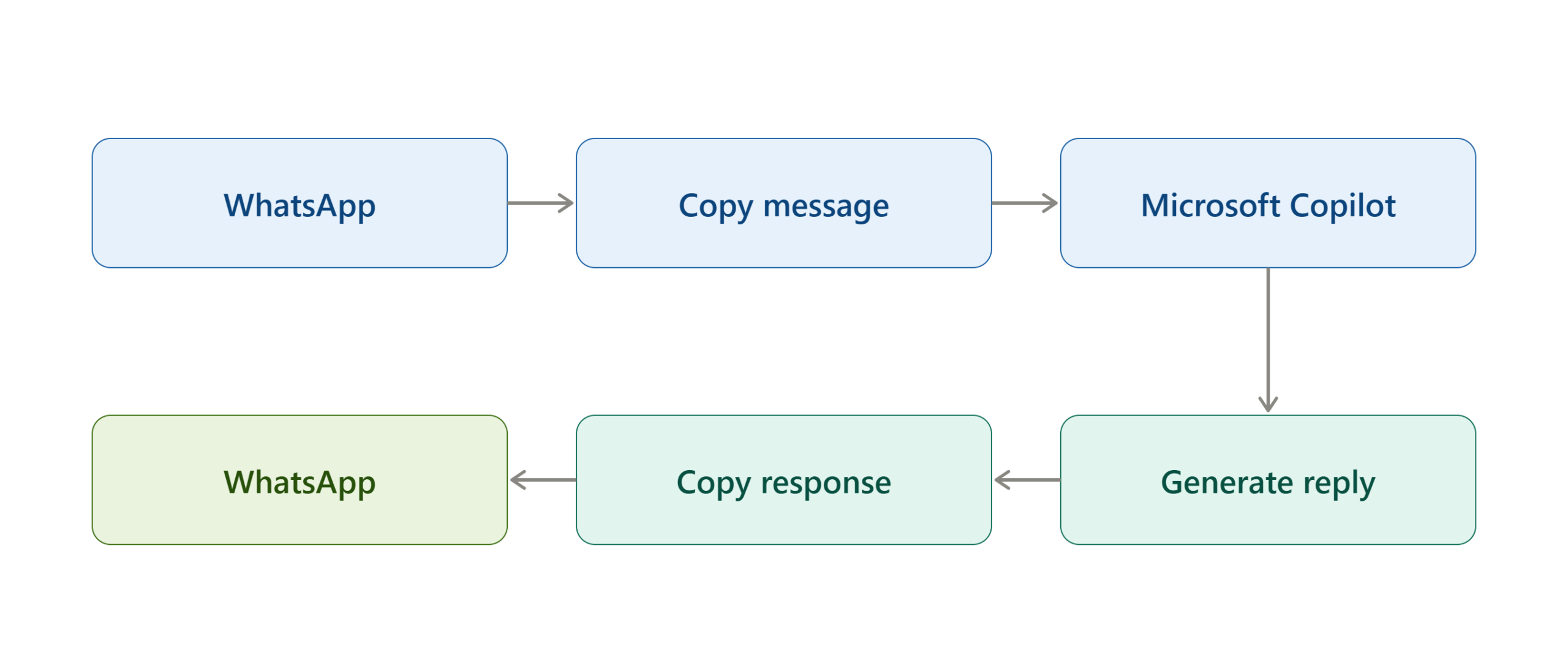
Method 2 — Use Copilot on the Web With WhatsApp Web
The second method is useful if you normally use WhatsApp on a computer.
Microsoft currently provides Copilot through the web, and Microsoft Support identifies the web experience as one of the supported ways to access Copilot.
At the same time, you can use WhatsApp Web in another browser tab or window.
Step 1 — Open WhatsApp Web
Open WhatsApp Web in your browser and sign in using the normal WhatsApp linking process.
Keep your WhatsApp conversation open.
Step 2 — Open Microsoft Copilot
Open Copilot in another browser tab or window.
Microsoft currently directs users to Copilot on the web as one of its supported access methods.
Step 3 — Copy the WhatsApp Message
Select the text from the WhatsApp conversation that you want Copilot to process.
For example, you might receive a long customer message asking several questions.
Copy the relevant text rather than sending unnecessary private information.
Step 4 — Paste It Into Copilot
Paste the text into Copilot.
Then give Copilot a specific instruction.
For example:
“Summarize this message into three key points and draft a professional reply.”
A clear instruction generally makes the desired output easier to obtain.
Step 5 — Review the Output
Read the generated response carefully.
Do not automatically assume that every statement produced by an AI assistant is correct, particularly when the message contains dates, prices, addresses, names, or other important information.
Step 6 — Paste the Response Into WhatsApp
Copy the final response from Copilot and paste it into the appropriate WhatsApp conversation.
Make any final edits before sending.
Why Use This Method?
The desktop workflow is particularly useful for long messages because copying, reviewing, and editing text can be easier with a physical keyboard.
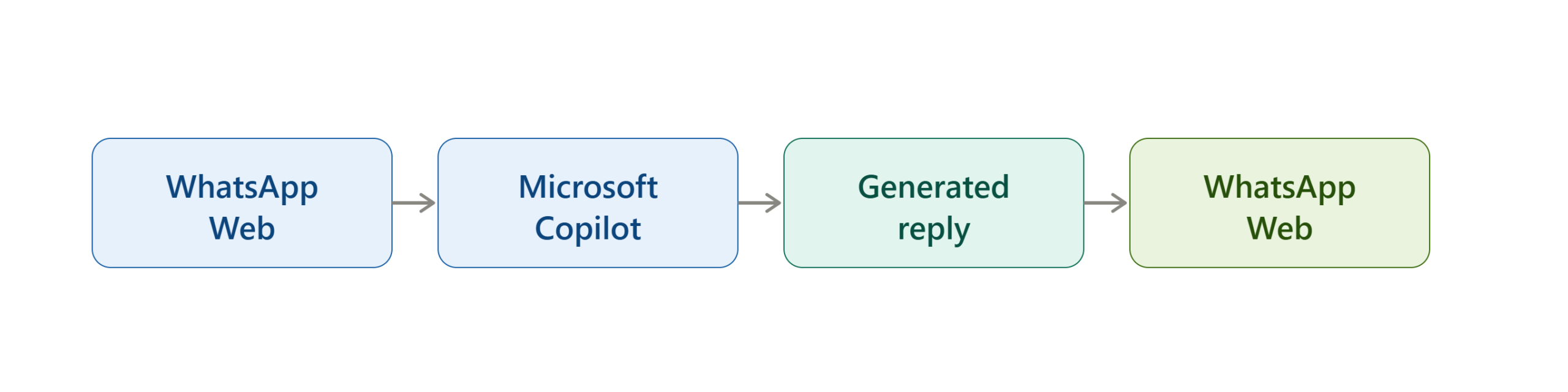
It also allows you to keep the two services visible at the same time. It also keeps the workflow simple:
Method 3 — Copy WhatsApp Content Into Copilot and Return the Result
The third method focuses on specific tasks rather than simply drafting replies.
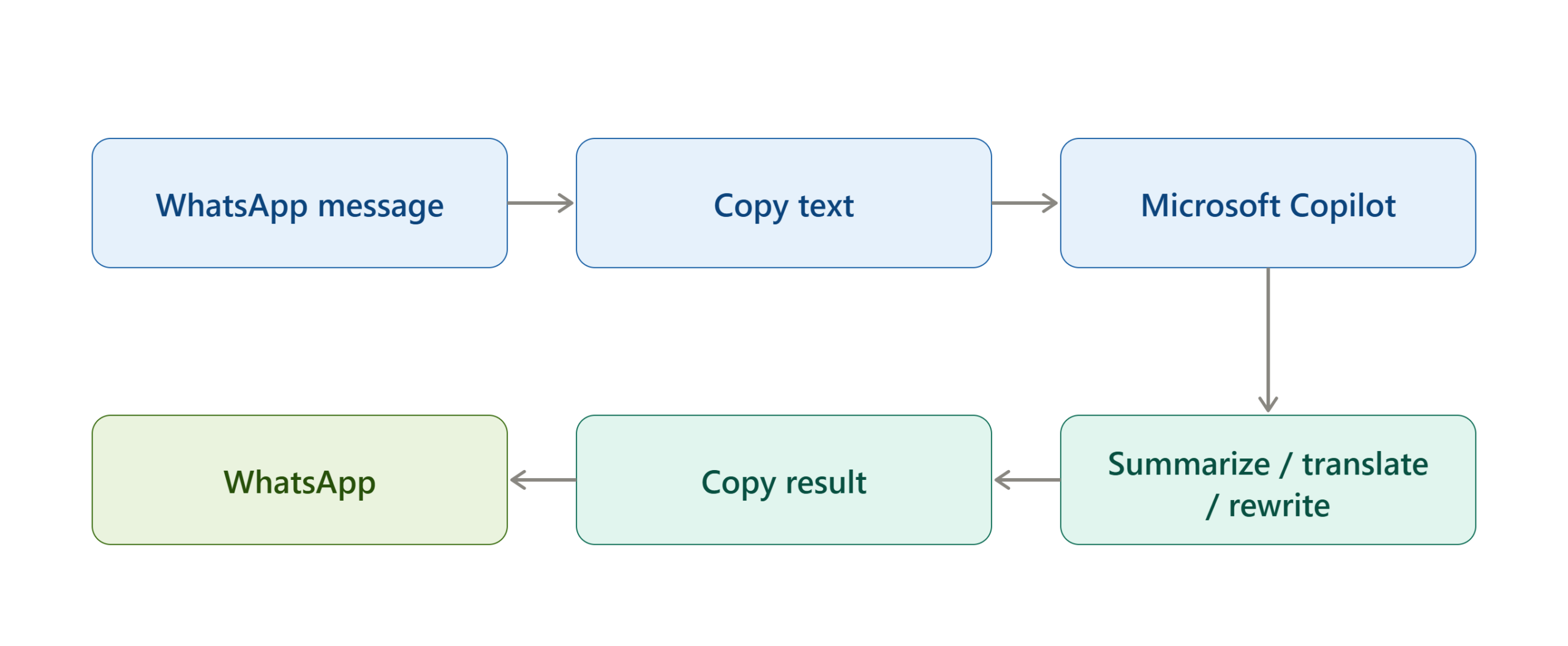
You can copy text from WhatsApp and ask Copilot to summarize, rewrite, translate, explain, organize, or improve it.
This is useful when the message is too long, confusing, or difficult to answer.
Step 1 — Select the WhatsApp Text
Open the relevant WhatsApp conversation.
Select and copy the message or portion of the conversation you need help with.
Avoid copying sensitive information unnecessarily.
Step 2 — Open Microsoft Copilot
Open the Copilot mobile app or web version.
Microsoft currently supports Copilot through both mobile and web access.
Step 3 — Describe the Task
Paste the message into Copilot and explain exactly what you want.
For example:
- For summarization: “Summarize this WhatsApp message in three short bullet points.”
- For translation: “Translate this message into natural English.”
- For rewriting: “Rewrite this message to sound polite and professional.”
- For explanation: “Explain what this message means in simple English.”
Step 4 — Review the Result
Check whether Copilot preserved the original meaning.
This is especially important when rewriting messages because an AI-generated response may change the tone or meaning if the instruction is too broad.
Step 5 — Copy the Result and Return to WhatsApp
Copy the useful output from Copilot. Go back to WhatsApp and paste the result.
Make any personal adjustments before sending or sharing it.
Why Use This Method?
This method is useful when you do not need a continuous Copilot conversation. Instead, you are using Copilot as a separate AI utility for a particular WhatsApp message. It also keeps the workflow simple:
Comparison of the 3 Current Methods
| Method | Best For | Device | Directly Inside WhatsApp? | Main Action |
|---|---|---|---|---|
| Copilot Mobile App | Quick replies and AI assistance | Android / iPhone | No | Switch between apps |
| Copilot + WhatsApp Web | Desktop messaging | Windows / Mac | No | Use two browser tabs/windows |
| Copy and Paste Workflow | Summaries, rewriting, translation | Mobile / Desktop | No | Move selected text between apps |
The key difference is convenience. None of these methods restores the discontinued Copilot WhatsApp chatbot; they provide practical ways to combine Copilot with WhatsApp.
Which Method Should You Use?
The choice depends mainly on how you use WhatsApp.
Use Method 1 if:
- You primarily use WhatsApp on your phone.
- You want help writing replies.
- You frequently need AI assistance.
- You are comfortable switching between apps.
Use Method 2 if:
- You use WhatsApp Web regularly.
- You work from a Windows PC or Mac.
- You handle longer messages.
- You prefer working with a physical keyboard.
Use Method 3 if:
- You only occasionally need AI assistance.
- You want to summarize long WhatsApp messages.
- You need translation or rewriting.
- You want to analyze a particular piece of text.
What Happened to the Old WhatsApp Copilot Number or QR Code?
Older Copilot tutorials may show a phone number or QR code that allowed users to start a WhatsApp conversation with Copilot.
Those instructions applied to the previous WhatsApp integration. Microsoft’s current announcement states that Copilot on WhatsApp stopped functioning after January 15, 2026.
Therefore, an old QR code should not be presented as a working 2026 installation method.
Why Old Tutorials Can Be Misleading
Search engines can continue to surface older pages and videos after a service changes.
A tutorial may correctly describe how Copilot worked in 2025 while being incorrect for someone searching in 2026.
For this topic, the publication date and official Microsoft documentation matter because the availability of the WhatsApp integration changed.
Before You Start
Before using one of the current methods, check the following:
- Install Copilot from an official Microsoft-supported source.
- Make sure your phone or computer has a working internet connection.
- Keep WhatsApp updated.
- Use a Microsoft account when required by the Copilot experience.
- Avoid sharing unnecessary private WhatsApp conversations with AI services.
- Review AI-generated messages before sending them.
- Do not rely on old Copilot WhatsApp phone numbers or QR codes.
Microsoft currently lists Copilot availability across mobile, web, Windows, and Mac.
How to Verify Copilot Is Working
After setting up one of the three methods, test it with a simple request.
For example:
“Rewrite this sentence to sound more professional: Can you send me the file?”
A successful setup should allow Copilot to process the request and return an answer. Then copy the result into a test WhatsApp chat or draft field.
You have successfully established the workflow when:
- Copilot accepts your prompt.
- Copilot generates a response.
- You can copy the response.
- WhatsApp accepts the pasted text.
- You can review and send the message normally.
Remember that this verifies Copilot working alongside WhatsApp, not a direct Copilot WhatsApp integration.
Troubleshooting Microsoft Copilot With WhatsApp
| Problem | Possible Cause | Solution |
|---|---|---|
| Copilot WhatsApp contact does not respond | Official WhatsApp service was discontinued | Use the Copilot app or web version |
| Old QR code does not work | The old WhatsApp integration ended | Do not rely on the old QR code |
| Copilot app cannot be found | Store, region, or device issue | Check Microsoft’s current supported access methods |
| Copy and paste does not work correctly | Text selection or app issue | Copy a smaller section and try again |
| Copilot produces an incorrect reply | Prompt lacks context or AI output is inaccurate | Add context and verify important details |
| Copilot asks you to sign in | Account authentication is required for some features | Sign in with the appropriate Microsoft account |
| WhatsApp message loses formatting | Formatting may not transfer during copying | Reformat the message inside WhatsApp |
| Copilot is unavailable in a region | Feature availability can vary | Check Microsoft’s supported regions and languages |
Microsoft says Copilot is available globally in more than 170 markets, although exceptions and feature differences can apply by region and language.
What If You See a “Copilot WhatsApp” Number Online?
Treat it carefully.
Microsoft’s official position is that its Copilot WhatsApp service was discontinued on January 15, 2026.
Therefore, a website claiming that you can activate the official Microsoft Copilot WhatsApp bot through a new number should be independently verified before you interact with it.
Do not provide passwords, authentication codes, payment information, or other sensitive account information to an unverified chatbot.
Is Microsoft SwiftKey a Current Copilot-on-WhatsApp Method?
This requires special clarification because some older 2026 tutorials recommend Microsoft SwiftKey.
Microsoft SwiftKey previously included Copilot-related features that could be useful while typing in apps such as WhatsApp. Microsoft’s documentation also describes AI-powered Tone functionality within SwiftKey.
However, Microsoft currently says that Copilot and Compose integration in SwiftKey have been removed and recommends using the standalone Copilot app instead.
Therefore, SwiftKey should not be presented as a current direct Copilot installation method for WhatsApp.
SwiftKey remains a Microsoft keyboard, and Microsoft documents its use on Android and iOS, but the current support guidance specifically says the Copilot and Compose integration has been removed.
Common Mistakes to Avoid
Mistake 1 — Following an Old WhatsApp QR-Code Tutorial
This happens because older Copilot tutorials remain online. The problem is that the official WhatsApp Copilot service ended in January 2026.
Correct approach: Use Microsoft’s current Copilot app or web experience instead.
Mistake 2 — Assuming the WhatsApp Number Is Still Official
An old Copilot contact may still appear in an old article or video. That does not mean the service is operational.
Correct approach: Check Microsoft’s current documentation before trusting a third-party setup method.
Mistake 3 — Calling SwiftKey a Direct Copilot Replacement
SwiftKey has had Copilot-related functionality, but Microsoft now states that its Copilot and Compose integration has been removed.
Correct approach: Use the standalone Copilot application when you specifically want Microsoft’s current Copilot experience.
Mistake 4 — Sending AI Output Without Reviewing It
Copilot can generate useful drafts, but the final WhatsApp message should still be reviewed.
Correct approach: Check: Names, Dates, Numbers, Links, Tone, Instructions, Personal information.
Mistake 5 — Sharing an Entire Private Conversation
You normally do not need to give an AI assistant an entire WhatsApp conversation to rewrite one sentence.
Correct approach: Copy only the information required for the task.
Privacy Considerations When Using Copilot With WhatsApp
When using Copilot with WhatsApp, remember that the workflow can involve moving information from one service to another.
For example, if you copy a private message from WhatsApp into Copilot, the text is no longer remaining solely within your WhatsApp conversation.
Before copying sensitive information, consider whether Copilot actually needs it.
Avoid unnecessarily sharing:
- Passwords
- Verification codes
- Banking information
- Private identification information
- Confidential business information
- Sensitive personal conversations
A useful rule is:
Give Copilot only the minimum information necessary to complete the task.
Expert Insights for Using Copilot With WhatsApp
The biggest practical change in 2026 is that users should stop thinking about Copilot as something that needs to be installed inside WhatsApp.
Instead, think of it as a separate AI workspace that can support WhatsApp communication.
This distinction produces a more reliable workflow:
WhatsApp = communication
Copilot = AI assistance
For short replies, switching between the mobile applications may be enough.
For long messages, desktop users may benefit from keeping WhatsApp Web and Copilot open in separate browser tabs.
For translation, summarization, or rewriting, the copy-and-paste workflow gives you more control over exactly what Copilot receives.
How to Write Better Copilot Prompts for WhatsApp
A vague prompt such as:
“Reply to this.” may not give you the tone you want.
A more specific instruction is:
“Write a short, friendly WhatsApp reply. Confirm that I received the message and say that I will respond tomorrow.”
You can also specify:
- Tone
- Length
- Language
- Audience
- Purpose
- Important information to retain
For example:
“Translate this message into natural Spanish and keep the tone friendly and informal.”
Or:
“Summarize this conversation into five bullet points. Do not add information that is not present in the text.”
Specific prompts make the workflow easier to control.
Current Copilot Access Options
Microsoft currently supports Copilot through several official surfaces.
| Platform | Current Availability |
|---|---|
| Android | Copilot mobile app |
| iPhone/iPad | Copilot mobile app |
| Web | Copilot through a browser |
| Windows | Copilot app |
| Mac | Copilot app |
| Direct Copilot service discontinued |
Microsoft’s current support documentation identifies desktop, web, and mobile as supported Copilot access routes.
Implementation Checklist
Before Starting
- Confirm that you understand the WhatsApp Copilot service was discontinued.
- Install Copilot from an official Microsoft-supported source.
- Make sure WhatsApp is working normally.
- Decide whether you want to use mobile or desktop.
During Use
- Copy only the necessary WhatsApp text.
- Give Copilot a specific instruction.
- Check the generated response.
- Correct names, dates, or other important details.
After Completion
- Paste the final response into WhatsApp.
- Review it one more time.
- Send it only after confirming the content is appropriate.
Frequently Asked Questions
Can I install Microsoft Copilot directly on WhatsApp in 2026?
No. Microsoft discontinued Copilot on WhatsApp on January 15, 2026. The current Microsoft-supported alternatives are Copilot’s mobile, web, Windows, and Mac experiences.
Does the old Microsoft Copilot WhatsApp number still work?
No. The official Copilot WhatsApp service ended on January 15, 2026. An old contact or QR code should not be treated as a current official access method.
Can I use Copilot while chatting on WhatsApp?
Yes. You can use the Copilot mobile app or web version separately, then copy relevant text between Copilot and WhatsApp.
Can I use Microsoft Copilot on WhatsApp Web?
You cannot install Copilot directly into WhatsApp Web, but you can open Copilot in another browser tab or window and use both services together.
Can Microsoft SwiftKey add Copilot to WhatsApp?
Microsoft currently says the Copilot and Compose integration in SwiftKey has been removed and recommends using the standalone Copilot app instead.
Is Microsoft Copilot available on Android and iPhone?
Yes. Microsoft currently provides Copilot mobile access for Android and iOS.
Why do some websites still show instructions for Copilot on WhatsApp?
Many pages and videos were created while the WhatsApp integration was active. Because Microsoft ended the service in January 2026, those older instructions can now be outdated.
What is the easiest way to use Copilot with WhatsApp?
For phone users, the simplest workflow is generally to use the Copilot mobile app alongside WhatsApp and copy text between the two applications.
Read More:
Conclusion:
Microsoft Copilot cannot currently be installed directly inside WhatsApp. The official Copilot WhatsApp service ended on January 15, 2026, so older tutorials showing a WhatsApp number, QR code, or direct Copilot chatbot should no longer be treated as current instructions.
The practical 2026 approach is to use Copilot alongside WhatsApp. Mobile users can use the Copilot app, desktop users can combine Copilot with WhatsApp Web, and anyone can copy WhatsApp text into Copilot for rewriting, summarizing, translating, or drafting before returning the result to WhatsApp.
The important distinction is simple: you cannot install the discontinued Copilot WhatsApp bot, but you can still use Microsoft Copilot effectively while using WhatsApp.